


启德考培大家带来了雅思考题回顾:希望以下内容能够为同学们的雅思备考提供帮助。
听力部分

1 61/71 Kviua Road
2 March
3 Australian
4 station
5 restaurant
6 120
7 sea view
8 bathroom
9 birds
10. helicopter

11. cars
12. 1928
13. cinema
14. quality
15. factory
16. waste
17. safety
18. website
19. customers
20. money

21. the originator of JIT
22. the definition of Just-in-time
23. textbook
24. service products are not accountable
配对25-30
25. too irregular
26. too informal
27. too technical
28. too sudden
29. loosely related
30. too unenthusiastic

31. conservation
32. eat
33. pond
34. male
35. water
36. agricultural
37. mountain
38. sea
39. habitat
40. disease
阅读部分
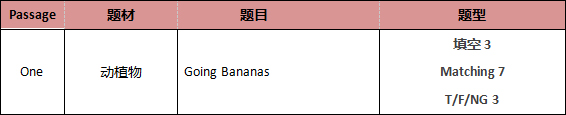
文章:
Going Bananas
The world’s favourite fruit could disappear forever in 10 years’ time.
The banana is among the world’s oldest crops. Agricultural scientists believe that the first edible banana was discovered around ten thousand years ago. It has been at an evolutionary standstill ever since it was first propagated in the jungles of South-East Asia at the end of the last ice age. Normally the wild banana, a giant jungle herb called Musa acuminata, contains a mass of hard seeds that make the fruit virtually inedible. But now and then, hunter-gatherers must have discovered rare mutant plants that produced seedless, edible fruits. Geneticists now know that the vast majority of these soft-fruited plants resulted from genetic accidents that gave their cells three copies of each chromosome instead of the usual two. This imbalance prevents seeds and pollen from developing normally, rendering the mutant plants sterile. And that is why some scientists believe the world’s most popular fruit could be doomed. It lacks the genetic diversity to fight off pests and diseases that are invading the banana plantations of Central America and the smallholdings of Africa and Asia alike.
In some ways, the banana today resembles the potato before blight brought famine to Ireland a century and a half ago. But it holds a lesson for other crops, too, says Emile Frison, top banana at the International Network for the Improvement of Banana and Plantain in Montpellier, France. The state of the banana, Frison warns, can teach a broader lesson: the increasing standardisation of food crops round the world is threatening their ability to adapt and survive.
The first Stone Age plant breeders cultivated these sterile freaks by replanting cuttings from their stems. And the descendants of those original cuttings are the bananas we still eat today. Each is a virtual clone, almost devoid of genetic diversity. And that uniformity makes it ripe for disease like no other crop on Earth. Traditional varieties of sexually reproducing crops have always had a much broader genetic base, and the genes will recombine in new arrangements in each generation. This gives them much greater flexibility in evolving responses to disease — and far more genetic resources to draw on in the face of an attack. But that advantage is fading fast, as growers increasingly plant the same few, high-yielding varieties. Plant breeders work feverishly to maintain resistance in these standardised crops. Should these efforts falter, yields of even the most productive crop could swiftly crash. “When some pest or disease comes along, severe epidemics can occur,” says Geoff Hawtin, director of the Rome-based International Plant Genetic Resources Institute.
The banana is an excellent case in point. Until the 1950s, one variety, the Gros Michel, dominated the world’s commercial banana business. Found by French botanists in Asia in the 1820s, the Gros Michel was by all accounts a fine banana, richer and sweeter than today’s standard banana and without the latter’s bitter aftertaste when green. But it was vulnerable to a soil fungus that produced a wilt known as Panama disease. “Once the fungus gets into the soil it remains there for many years. There is nothing farmers can do. Even chemical spraying won’t get rid of it,” says Rodomiro Ortiz, director of the International Institute for Tropical Agriculture in Ibadan, Nigeria. So plantation owners played a running game, abandoning infested fields and moving to “clean” land — until they ran out of clean land in the 1950s and had to abandon the Gros Michel. Its successor, and still the reigning commercial king, is the Cavendish banana, a 19th-century British discovery from southern China. The Cavendish is resistant to Panama disease and, as a result, it literally saved the international banana industry. During the 1960s, it replaced the Gros Michel on supermarket shelves. If you buy a banana today, it is almost certainly a Cavendish. But even so, it is a minority in the world’s banana crop.
Half a billion people in Asia and Africa depend on bananas. Bananas provide the largest source of calories and are eaten daily. Its name is synonymous with food.But the day of reckoning may be coming for the Cavendish and its indigenous kin. Another fungal disease, black Sigatoka, has become a global epidemic since its first appearance in Fiji in 1963. Left to itself, black Sigatoka — which causes brown wounds on leaves and premature fruit ripening — cuts fruit yields by 50 to 70 per cent and reduces the productive lifetime of banana plants from 30 years to as little as 2 or 3. Commercial growers keep Sigatoka at bay by a massive chemical assault.Forty sprayings of fungicide a year is typical. But even so, diseases such as black Sigatoka are getting more and more difficult to control. “As soon as you bring in a new fungicide, they develop resistance,” says Frison. “One thing we can be sure of is that the Sigatoka won’t lose in this battle.” Poor farmers, who cannot afford chemicals, have it even worse. They can do little more than watch their plants die. “Most of the banana fields in Amazonia have already been destroyed by the disease,” says Luadir Gasparotto, Brazil’s leading banana pathologist with the government research agency EMBRAPA. Production is likely to fall by 70 per cent as the disease spreads, he predicts. The only option will be to find a new variety.
But how? Almost all edible varieties are susceptible to the diseases, so growers cannot simply change to a different banana. With most crops, such a threat would unleash an army of breeders, scouring the world for resistant relatives whose traits they can breed into commercial varieties. Not so with the banana. Because all edible varieties are sterile, bringing in new genetic traits to help cope with pests and diseases is nearly impossible. Nearly, but not totally. Very rarely, a sterile banana will experience a genetic accident that allows an almost normal seed to develop, giving breeders a tiny window for improvement. Breeders at the Honduran Foundation of Agricultural Research have tried to exploit this to create disease-resistant varieties. Further backcrossing with wild bananas yielded a new seedless banana resistant to both black Sigatoka and Panama disease.
Neither Western supermarket consumers nor peasant growers like the new hybrid. Some accuse it of tasting more like an apple than a banana. Not surprisingly, the majority of plant breeders have until now turned their backs on the banana and got to work on easier plants. And commercial banana companies are now washing their hands of the whole breeding effort, preferring to fund a search for new fungicides instead. “We supported a breeding programme for 40 years, but it wasn’t able to develop an alternative to Cavendish. It was very expensive and we got nothing back,” says Ronald Romero, head of research at Chiquita, one of the Big Three companies that dominate the international banana trade.
Last year, a global consortium of scientists led by Frison announced plans to sequence the banana genome within five years. It would be the first edible fruit to be sequenced. Well, almost edible. The group will actually be sequencing inedible wild bananas from East Asia because many of these are resistant to black Sigatoka. If they can pinpoint the genes that help these wild varieties to resist black Sigatoka, the protective genes could be introduced into laboratory tissue cultures of cells from edible varieties. These could then be propagated into new, resistant plants and passed on to farmers.
It sounds promising, but the big banana companies have, until now, refused to get involved in GM research for fear of alienating their customers. “Biotechnology is extremely expensive and there are serious questions about consumer acceptance,”says David McLaughlin, Chiquita’s senior director for environmental affairs. With scant funding from the companies, the banana genome researchers are focusing on the other end of the spectrum. Even if they can identify the crucial genes, they will be a long way from developing new varieties that smallholders will find suitable and affordable. But whatever biotechnology’s academic interest, it is the only hope for the banana. Without it, banana production worldwide will head into a tailspin. We may even see the extinction of the banana as both a lifesaver for hungry and impoverished Africans and as the most popular product on the world’s supermarket shelves.
Questions 1-3
Complete the sentences below with NO MORE THAN THREE WORDS from the passage.
Write your answers in boxes 1-3 on your answer sheet.
1 The banana was first eaten as a fruit by humans almost _ten thousand_ years ago.
2 Bananas were first planted in __South-East Asia____.
3 The taste of wild bananas is adversely affected by its __hard seeds____.
Questions 4-10
Look at the following statements (Questions 4-10) and the list of people below.
Match each statement with the correct person, A-F.
Write the correct letter, A-F, in boxes 4-10 on your answer sheet.
NB You may use any letter more than once.
4 A pest invasion may seriously damage the banana industry. F
5 The effect of fungal infection in soil is often long-lasting. A
6 A commercial manufacturer gave up on breeding bananas for disease resistant species. D
7 Banana disease may develop resistance to chemical sprays. C
8 A banana disease has destroyed a large number of banana plantations. E
9 Consumers would not accept genetically altered crop. B
10 Lessons can be learned from bananas for other crops. C
List of people
A Rodomiro Oritz
B David McLaughlin
C Emile Frison
D Ronald Romero
E Luadir Gasparotto
F Geoff Hawtin
Questions 11-13
Do the following statements agree with the information given in Reading Passage 1?
In boxes 11-13 on your answer sheet, write
TRUE if the statement agrees with the information
FALSE if the statement contradicts the information
NOT GIVEN if there is no information on this
11 The banana is the oldest known fruit. Not Given
12 The Gros Michel is still being used as a commercial product. False
13 Banana is the main food in some countries. True

文章:
The Lost City
Thanks to modern remote-sensing techniques, a ruined city in Turkey is slowly revealing itself as one of the greatest and most mysterious cities of the ancient world. Sally Palmer uncovers more.
The low granite mountain, known as Kerkencs Dag. juts from the northern edge of the C'appadocian plain in Turkey. Sprawled over the mountainside are the rums of an enormous city, contained by crumbling defensive walls seven kilometers long. Many respected archaeologists believe these are the remains of the fabled city of Plena, the sixth-century BC stronghold of the Mcdes that the Greek historian Herodotus described in his famous work The Histories. The short-lived city came under Median control and only fifty years later was sacked. burned and its strong stone walls destroyed.
British archeologist Dr Geoffrey Summer* has spent ten years studying the site. Excavating the ruins is a challenge because of the vast area they cover. The 7 km perimeter walls run around a site covering 271 hectares. Dr Summers quickly realised it would take far too long to excavate the site using traditional techniques alone. So he decided to use modem technology as well to map the entire site, both above and beneath the surface, to locate the most interesting areas and priorities to start digging.
In 1993. Dr Summers hired a special hand held balloon with a remote-controlled camera attached. He walked over the entire site holding the balloon and taking photos. Then one afternoon, he rented a hot-air balloon and floated over the site, taking yet more pictures By the end of the 1994 season. Dr Summers and his team had a jigsaw of aerial photographs of the whole site. The next stage was to u&c remote sensing, which would let them work out what lay below the intriguing outlines and ruined walls. "Archaeology is a discipline that lends itself very well to remote sensing because it revolves around space," says Scott Brantmg. an associated director of the project, lie started working with Dr Summers in 1995.
The project used two remote sensing techniques. The first is magnetometry which works on the principle thai magnetic fields al the surface of the Earth are influenced by what it buried beneath. It measures localised variations in the direction and intensity of this magnetic field. "The Earth's magnetic field can vary from place to placc, depending on what happened there in the past." says Branting. "if something containing iron oxide was heavily burnt, by natural or human actions, the iron particles in it can be permanently reoriented, like a compass needle, to align with the Earth's magnetic field present at that point in time and space." The magnetometer detects differences in the orientations and intensities of these iron particles from the present-day magnetic field and uses them to produce an image of what lies below ground.
Kerienes Dag lends itself particularly well to magnctomctry because it was all burnt at once in a savage fire. In places the heat was sufficient to turn sandstone to glass and to melt granite. The fire was so hot that there were strong magnetic signanires set to the Earth's magnetic field from the time - around 547 BC - resulting in extremely clear pictures. Furthermore, the city was never rebuilt, "if you have multiple layers confusing picture, because you have different walls from different periods giving signatures that all go in different directions," says Branting. "We only have one going down about 1.5 meters, so we can get a good picture of this fairly short-lived city ."
The other main sub-surface mapping technique, which is still being used at the site, is
resistivity. This technique measures the way electrical pulses arc conducted through sub- surface soil. It's done by shooting pulses into the ground through a thin metal probe. Different materials have different electrical conductivity. For example, stone and mudbnek arc poor conductors, but looser, damp soil conducts very well. By walking around the site and taking about four readings per metre, it is possible to get a detailed idea of what is where beneath the surface. The teams then build up picnires of walls, hearths and other remains. "It helps a lot if it has rained, because the electrical pulse can get through more easily," says Branting. "Then if something is more resistant, it really shows up." This is one of the reasons that the project has a spring season, when most of the resistivity work is done. Unfortunately testing resistivity is a lot slower than magnetometry. "If we did (r the whole site it would take about 100 years," says Branting. Consequently, the team is concentrating on areas where they want to clarify pictures from the magnetometry.
Remote sensing does not reveal everything about Kerkenes Dag. but it shows the most interesting sub-surface areas of the site. The archaeologists can then excavate these using traditional techniques. One surprise came when they dug out one of the fates in the defensive walls. "Our observations in early seasons led us to assume that wall, such as would be found at most other cities in the Ancient Near East," says Dr Summers. "When we started to excavate we were staggered to discover that the walls were made entirely from stone and that the gate would have stood at least ten metres high. After ten years of study, Pteria is gradually giving up its secrets."
Questions 14-17
Reading Passage 2 has seven paragraphs, A-G
Which paragraph contains the following information?
Write the correct letter, A-G, in boxes 14-17on your answer sheet.
14. The reason why various investigative methods are introduced. B
15. An example of an unexpected discovery. G
16. The methods to surveyed the surface of the site from above. C
17. The reason why experts want to study the site. A
Question 18-25
Summary
Complete the following summary of the paragraphs of Reading Passage, using no more than three words from the Reading Passage for each answer. Write your answers in boxes 18-25 on your answer sheet.
18. hot-air balloon
19. iron particles
20. compass needle
21. thin metal probe
22. mudbrick
23. loose, damp soils
24. spring seasons
25. clarify
Question 26
B They bring parts of the site into light so that key areas can be researched further.

文章大意:全球化和技术
现在经济全球化,引进先进技术是热门的话题,虽然发展中国家需要引进先进的技术,但他们缺乏人力,技能,资源如石油天然气等等,信息技术被认为是发展经济的好办法,在一些发展中国家,信息可能有一些好处,所以在发展中国家,可以适当的发展微小型企业,并同时发展当地产业。
参考题目:
填空
27. leaders
28. automation
29. capital
30. resources
31. B widen the economic difference
32. B linked to road program
判断题:
1. The use of technology is unavoidable
2. People fell happier when they use New small-businesses.
3. Small-scale business is still useful while expended
答案待补充
写作部分

考试热门工具预约
- 测启德在线学习系统,免费开放预约
- 练丰富题库免费预约试用
- 学0元免费预约公开课
- 评实地测试,老师测评,免费开放预约

雅思口语Part2话题卡怎么准备万能素材
2026/09/18 18:46:04

雅思考试前一周怎么冲刺复习
2026/09/18 18:45:55

雅思G类和A类成绩哪个认可度高
2026/09/18 18:45:47

雅思成绩什么时候提交申请最合适
2026/09/18 18:45:38

雅思口语Part1常见问题及回答思路
2026/09/18 18:45:30

托福成绩可以替代雅思申请英国大学吗
2026/09/18 18:45:21