


听力部分

1-4 matching
A. A. Sold out B. B. No cheap ticket available C. C. Dates changed D. D. New starting time E. E. Cancel F. F. Different performers G. For free |
Question1---D Question2---E Question3---G Question4---A |
Question5-10
5. New opera
6. Ticket price: 30 pounds
7. place1: theatre
8. place 2:library
9. place:3:town hall
10.place 5: studio

11.A. closing fee 里面包含了inspection fee
12.B. 每个月都要买的insurance
13.A
14.C.街区一 适合家庭
15.B街区二 有很多步行公园
16. A街区三 适合larger budget的人
17-20待回忆

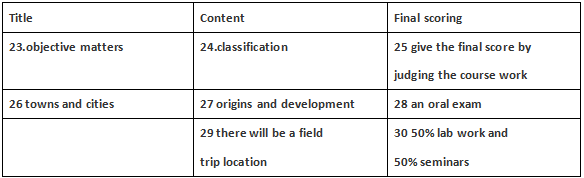
21. the course Archaeology couldn’t be selected with classical history
22.three compulsory modules.

In ancient history
31.extreme sport is also known as lifestyle sports
32. better equipment makes it safer
In the 19th century
33.an extreme sport was created by company workers in 19th century
34. at the end of 19th century, other sports had been created like golf in higher social class
In the 21st century
35. why people don’t like traditional sports, like basketball
36.reason1:there are too many restricted regulations
37.reason2.it needs regular training
38.help them confront fear
In the future
39 young people think that government should provide them with more entertainment sports instead of individual competition
40 they tend to think that extremely sports is not a conflict to our authority but also give us a sense of community
阅读部分

参考文章
A
THERE’S no animal that symbolises rainforest diversity quite as spectacularly as the tropical butterfly. Anyone lucky enough to see these creatures flitting between patches of sunlight cannot fail to be impressed by the variety of theirpatterns. But why do they display such colourful exuberance? Until recently, this was almost as pertinent a question as it had been when the 19th-century naturalists, armed only with butterfly nets and insatiable curiosity, battled through the rainforests. These early explorers soon realised that although some of the butterflies’ bright colours are there to attract a mate, others are warning signals. They send out a message to any predators: “Keep off, we're poisonous.” And because wearing certain patterns affords protection, other species copy them. Biologists use the term “mimicry rings” for these clusters of impostors and their evolutionary idol.
B
But here's the conundrum. “Classical mimicry theory says that only a single ring should be found in any one area,” explains George Beccaloni of the Natural History Museum, London. The idea is that in each locality there should be just the one pattern that best protects its wearers. Predators would quickly learn to avoid it and eventually all mimetic species in a region should converge upon it. “The fact that this is patently not the case has been one of the major problems in mimicry research,” says Beccaloni. In pursuit of a solution to the mystery of mimetic exuberance, Beccaloni set off for one of the megacentres for butterfly diversity, the point where the western edge of the Amazon basin
meets the foothills of the Andes in Ecuador. “It’s exceptionally rich, but
comparatively well collected, so I pretty much knew what was there, says
Beccaloni.” The trick was to work out how all the butterflies were organised and how this related to mimicry.”
C
Working at the Jatun Sacha Biological Research Station on the banks of
the Rio Napo, Beccaloni focused his attention on a group of butterflies
called ithomiines. These distant relatives of Britain’s Camberwell Beauty
are abundant throughout Central and South America and the Caribbean.
They are famous for their bright colours, toxic bodies and complex mimetic relationships. “They can comprise up to 85 per cent of the individuals in a mimicry ring and their patterns are mimicked not just by butterflies, but by other insects as diverse as damselflies and true bugs,” says Philip DeVries of the Milwaukee Public Museum’s Center for Biodiversity Studies.
D
Even though all ithomiines are poisonous, it is in their interests to evolve
to look like one another because predators that learn to avoid one species
will also avoid others that resemble it. This is known as Miillerian mimicry. Mimicry rings may also contain insects that are not toxic, but gain protection by looking likes a model species that is: an adaptation called Batesian mimicry. So strong is an experienced predator’s avoidance response that even quite inept resemblance gives some protection. “Often there will be a whole series of species that mimic, with varying degrees of verisimilitude, a focal or model species,” says John Turner from the University of Leeds. “The results of these deceptions are some of the most exquisite examples of evolution known to science.” In addition to colour, many mimics copy behaviours and even the flight pattern of their model species.
E
But why are there so many different mimicry rings? One idea is that species flying at the same height in the forest canopy evolve to look like one another. “It had been suggested since the 1970s that mimicry complexes were stratified by flight height,” says DeVries. The idea is that wing colour patterns are camouflaged against the different patterns of light and shadow at each level in the canopy, providing a first line of defence against predators.” But the light patterns and wing patterns don’t match very well,” he says. And observations show that the insects do not shift in height as the day progresses and the light patterns change. Worse still, according to DeVries, this theory doesn’t explain why the model species is flying at that particular height in the first place.
F
“When I first went out to Ecuador, I didn’t believe the flight height hypothesis and set out to test it,” says Beccaloni.”A few weeks with the collecting net convinced me otherwise. They really flew that way.” What he didn’t accept, however, was the explanation about light patterns. “I thought, if this idea really is true, and I can work out why, it could help explain why there are so many different warning patterns in any one place. Then we might finally understand how they could evolve in such a complex way.” The job was complicated by the sheer diversity of species involved at Jatun Sacha. Not only were there 56 ithomiine butterfly species divided among eight mimicry rings, there were also 69 other insect species, including 34 day-flying moths and a damselfly, all in a
200-hectare study area. Like many entomologists before him, Beccaloni used a large bag-like net to capture his prey. This allowed him to sample the 2.5 metres immediately above the forest floor. Unlike many previous workers, he kept very precise notes on exactly where he caught his specimens.
G
The attention to detail paid off. Beccaloni found that the mimicry rings were flying at two quite separate altitudes. “Their use of the forest was quite distinctive,” he recalls. “For example, most members of the clear-winged mimicry ring would fly close to the forest floor, while the majority of the 12 species in the tiger-winged ring fly high up.” Each mimicry ring had its own characteristic flight height.
H
However, this being practice rather than theory, things were a bit fuzzy. “They'd spend the majority of their time flying at a certain height. But they'd also spend a smaller proportion of their time flying at other heights,” Beccaloni admits. Species weren’t stacked rigidly like passenger jets waiting to land, but they did appear to have a preferred airspace in the forest. So far, so good, but he still hadn’t explained what causes the various groups of ithomiines and their chromatic consorts to fly in formations at these particular heights.
I
Then Beccaloni had a bright idea. “I started looking at the distribution of ithomiine larval food plants within the canopy,” he says. “For each one I’d record the height to which the host plant grew and the height above the ground at which the eggs or larvae were found. Once I got them back to the field station’s lab, it was just a matter of keeping them alive until they pupated and then hatched into adults which I could identify.”
参考答案:
1. E
2. B
3. G
4. F
5. D
6. FALSE
7. TRUE
8. NOT GIVEN
9. FALSE
10. NOT GIVEN
11. TRUE
12. D
13. B

答案:
14. vi
15. viii
16. v
17. iii
18. ix
19. vii
20. ii
21. D
22. B
23. C
24. Density
25. Architects
26. Budget
27. Garden

参考文章: THE GAP of INGENUITY
Ingenuity, as I define it here, consists not only of ideas for new technologies like computers or drought-resistant crops but, more fundamentally, of ideas for better institutions and social arrangements, like efficient markets and competent governments.
How much and what kinds of ingenuity a society requires depends on a range of factors, including the society's goals and the circumstances within which it must achieve those goals——whether it has a young population or an aging one, an abundance of natural resources or a scarcity of them, an easy climate or a punishing one, whatever the case may be.
How much and what kinds of ingenuity a society supplies also depends on many factors, such as the nature of human inventiveness and understanding, the rewards an economy gives to the producers of useful knowledge, and the strength of political opposition to social and institutional reforms.
A good supply of the right kind of ingenuity is essential, but it isn't, of course, enough by itself. We know that the creation of wealth, for example, depends not only on an adequate supply of useful ideas but also on the availability of other, more conventional factors of production, like capital and labor. Similarly, prosperity, stability and justice usually depend on the resolution, or at least the containment, of major political struggles over wealth and power. Yet within our economics ingenuity often supplants labor, and growth in the stock of physical plant is usually accompanied by growth in the stock of ingenuity. And in our political systems, we need great ingenuity to set up institutions that successfully manage struggles over wealth and power. Clearly, our economic and political processes are intimately entangled with the production and use of ingenuity.
The past century’s countless incremental changes in our societies around the planet, in our technologies and our interactions with our surrounding natural environments have accumulated to create a qualitatively new world. Because these changes have accumulated slowly, It’s often hard for us to recognize how profound and sweeping they've. They include far larger and denser populations; much higher per capita consumption of natural resources; and far better and more widely available technologies for the movement of people, materials, and especially information.
In combination, these changes have sharply increased the density, intensity, and pace of our inter actions with each other; they have greatly increased the burden we place on our natural environment; and they have helped shift power from national and international institutions to individuals and subgroups, such as political special interests and ethnic factions.
As a result, people in all walks of life-from our political and business leaders to all of us in our day-to-day——must cope with much more complex, urgent, and often unpredictable circumstances. The management of our relationship with this new world requires immense and ever-increasing amounts of social and technical ingenuity. As we strive to maintain or increase our prosperity and improve the quality of our lives, we must make far more sophisticated decisions, and in less time, than ever before.
When we enhance the performance of any system, from our cars to the planet's network of financial institutions, we tend to make it more complex. Many of the natural systems critical to our well-being, like the global climate and the oceans, are extraordinarily complex to begin with. We often can't predict or manage the behavior of complex systems with much precision, because they are often very sensitive to the smallest of changes and perturbations, and their behavior can flip from one mode to another suddenly and dramatically. In general, as the human-made and natural systems we depend upon become more complex, and as our demands on them increase, the institutions and technologies we use to manage them must become more complex too, which further boosts our need for ingenuity.
The good news, though, is that the last century's stunning changes in our societies and technologies have not just increased our need for ingenuity; they have also produced a huge increase in its supply. The growth and urbanization of human populations have combined with astonishing new communication and transportation technologies to expand interactions among people and produce larger, more integrated, and more efficient markets. These changes have, in turn, vastly accelerated the generation and delivery of useful ideas.
But—and this is the critical "but"——we should not jump to the conclusion that the supply of ingenuity always increases in lockstep with our ingenuity requirement: While it's true that necessity is often the mother of invention, we can't always rely on the right kind of ingenuity appearing when and where we need it. In many cases, the complexity and speed of operation of today's vital economic, social, arid ecological systems exceed the human brains grasp. Very few of us have more than a rudimentary understanding of how these systems work. They remain fraught with countless "unknown unknowns," which makes it hard to supply the ingenuity we need to solve problems associated with these systems.
In this book, explore a wide range of other factors that will limit our ability to supply the ingenuity required in the coming century. For example, many people believe that new communication technologies strengthen democracy and will make it easier to find solutions to our societies' collective problems, but the story is less clear than it seems. The crush of information in our everyday lives is shortening our attention span, limiting the time we have to reflect on critical matters of public policy, and making policy arguments more superficial.
Modern markets and science are an important part of the story of how we supply ingenuity. Markets are critically important, because they give entrepreneurs an incentive to produce knowledge. As for science, although it seems to face no theoretical limits, at least in the foreseeable future, practical constraints often slow its progress. The cost of scientific research tends to increase as it delves deeper into nature. And science's rate of advance depends on the characteristic of the natural phenomena it investigates, simply because some phenomena are intrinsically harder to understand than others, so the production of useful new knowledge in these areas can be very slow. Consequently, there is often a critical time lag between the recognition between a problem and the delivery of sufficient ingenuity, in the form of technologies, to solve that problem. Progress in the social sciences is especially slow, for reasons we don't yet understand; but we desperately need better social scientific knowledge to build the sophisticated institutions today’s world demands.
Questions:
Complete each sentence with the appropriate answer, A, B, C, or D
Write the correct answer in boxes 27-30 on your answer sheet.
27 The definition of ingenuity
28 The requirement for ingenuity
29 The creation of social wealth
30 The stability of society
A depends on many factors including climate.
B depends on the management and solution of disputes.
C is not only of technological advance, but more of institutional renovation.
D also depends on the availability of some traditional resources.
Question 31-33
Choose the correct letter, A, B, C, or D.
Write your answers in boxes 31-33 on your answer sheet.
31 What does the author say about the incremental change of the last 100 years?
A It has become a hot scholastic discussion among environmentalists.
B Its significance is often not noticed.
C It has reshaped the natural environments we live in.
D It benefited a much larger population than ever.
32 The combination of changes has made life.
A easier
B faster
C slower
D less sophisticated
33 What does the author say about the natural systems?
A New technologies are being developed to predict change with precision.
B Natural systems are often more sophisticated than other systems.
C Minor alterations may cause natural systems to change dramatically.
D Technological developments have rendered human being more independent of natural systems.
Question 34-40
Do the following statements agree with the information given in Reading Passage 3?
In boxes 34-40 on your answer sheet, write
YES if the statement is true
NO if the statement is false
NOT GIVEN if the information is not given in the passage
34 The demand for ingenuity has been growing during the past 100 years.
35 The ingenuity we have may be inappropriate for solving problems at hand.
36 There are very few who can understand the complex systems of the present world.
37 More information will help us to make better decisions.
38 The next generation will blame the current government for their conduct.
39 Science tends to develop faster in certain areas than others.
40 Social science develops especially slowly because it is not as important as natural science.
27. C
28. A
29. D
30. B
31. B
32. B
33. C
34. YES
35. YES
36. YES
37. NO
38. NOT GIVEN
39. YES
40. NO
写作部分


相似旧题:
2008.02.23
In some countries, it is now possible for people to buy a wide variety of foods transported from all over the world. To what extent do the benefits of this development outweigh the drawbacks?
欢迎访问启德考培北京分校 欢迎咨询启德考培学习顾问
免费获取备考提分解决方案,您可以通过以下3种方式联络我们:
1、欢迎致电启德考培客户服务中心400-100-0918;
2、欢迎 点击这里 进行网络咨询;
3、填写表单,我们会在1-3天内为您提供专业的服务。
考试热门工具预约
- 测启德在线学习系统,免费开放预约
- 练丰富题库免费预约试用
- 学0元免费预约公开课
- 评实地测试,老师测评,免费开放预约

雅思口语Part2话题卡怎么准备万能素材
2026/09/18 18:46:04

雅思考试前一周怎么冲刺复习
2026/09/18 18:45:55

雅思G类和A类成绩哪个认可度高
2026/09/18 18:45:47

雅思成绩什么时候提交申请最合适
2026/09/18 18:45:38

雅思口语Part1常见问题及回答思路
2026/09/18 18:45:30

托福成绩可以替代雅思申请英国大学吗
2026/09/18 18:45:21