


听力部分

1. climbing
2. shoes
3. pizza
4. city
5. football
6. dancing
7. PAIGE
8. 65
9. 150
10. transporting

11-15 单选题
11. A. sports ground
12. B. shoe
13. A. yellow
14. B. handing out water
15-20 地图题

15. F. stage
16. A. T-shirt
17. B. bag collection
18. H. information center
19. G. prize
20. I

21. C. fill in form
22. A. 450
23. A. rain evaporate faster than fall
24. B. marine desert
25. C. birds
26-30 填空题
26. life science graduate
27. ship
28. journal
29. 12000
30. earth

31. mothers
32. layers
33. rope
34. rain
35. work
36. weight
37. bones
38. danger
39. wild
40. sensitive
阅读部分
1-6 笔记填空

1. Primates
2. 400
3. Drop
4. Nightclub
5. Music
6. 95%
8-13 判断
7. TRUE (hearing and vision can exactly locate对应原文locate with precision)
8. TRUE (在复杂气味中只能识别一些,对应原文4种)
9. FALSE (在识别其为使需要professionals, 原文说我们自己就有这种能力)
10. FALSE
11. FALSE (pleasant smell can evoke the strongest emotion, 原文说unpleasant能引发更强记忆)
12. NOT GIVEN (sense of smell reduce in adulthood, 原文未提及)
13. TRUE (与记忆相关的气味可以让我们想起童年经历)
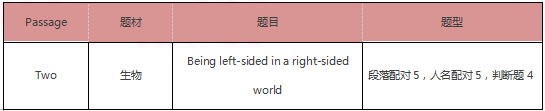
参考文章
READING PASSAGE 2
You should spend about 20 minutes on Questions 14-26 which are based on Reading Passage 2 below
Being Left-sided in Right-sided world
The world is designed for right-handed people. Why does a tenth of the population prefer the left.
A. The probability that two right-handed people would have a left-handed child is only about 9.5 percent. The chance rises to 19.5 percent if one parent is a lefty and 26 percent if both parents are left-handed: The preference, however, could also stem from an infant’s imitation of his parents. To test genetic influence, starting in the 1970s British biologist Marian Annett of the University of Leicester hypothesized that no single gene determines handedness. Rather, during fatal development, a certain molecular factor helps to strengthen the brain’s left hemisphere, which increases the probability that the right hand will be dominant, because the left side of the brain controls the right side of the body, and vice versa. Among the minority of people who lack this factor, handedness develops entirely by chance. Research conducted on twins complicates the theory, however. One in five sets of identical twins involves one right-handed and one left-handed person, despite the fact that their genetic material is the same. Genes, therefore, are not solely responsible for handedness.
B. Genetic theory is also undermined by results from Peter Hepper and his team at Queen’s University in Belfast, Ireland. In 2004 the psychologists used ultra sound to show that by the 15th week of pregnancy, fetuses already have a preference as to which thumb they suck. In most cases, the preference continued after birth. At 15 weeks, though, the brain does not yet have control over the body's limbs. Hepper speculates that fetuses tend to prefer whichever side of the body is developing quicker and that their movements, in turn, influence the brain's development. Whether this early preference is temporary or holds up throughout development and infancy is unknown. Genetic predetermination is also contradicted by the widespread observation that children do not settle on either their right or left hand until they are two or three year sold.
C. But even if these correlations were true, they did not explain what actually causes left-handedness. Furthermore, specialization on either side of the body is common among animals. Cats will favor one paw over another when fishing toys out from under the couch. Horses stomp more frequently with one hoof than the other. Certain crabs motion predominantly with the left or right claw. In evolutionary terms, focusing power and dexterity in one limb is more efficient than having to train two, four or even eight limbs equally. Yet for most animals, the preference for one side or the other is seemingly random. The overwhelming dominance of the right hand is associated only with humans. That fact directs attention toward the brain’s two hemispheres and perhaps toward language.
D. Interest in hemispheres dates back to at least 1836. That year, at a medical conference, French physician Marc Dax reported on an unusual commonality among his patients. During his many years as a country doctor, Dax had encountered more than 40 men and women for whom speech was difficult, the result of some kind of brain damage. What was unique was that every individual suffered damage to the left side of the brain. At the conference, Dax elaborated on his theory, stating that each half of the brain was responsible for certain functions and that the left hemisphere controlled speech. Other experts showed little interest in the Frenchman’s ideas. Over time, however, scientists found more and more evidence of people experiencing speech difficulties following injury to the left brain. Patients with damage to the right hemisphere most often displayed disruptions in perception or concentration. Major advancements in understanding the brain’s asymmetry were made in the 1960s as a result of so -called split-brain surgery, developed to help patients with epilepsy. During this operation, doctors severed the corpus callous — the nerve bundle that connects the two hemispheres. The surgical cut also stopped almost all normal communication between the two hemispheres, which offered researchers the opportunity to investigate each side’s activity.
E. In 1949 neurosurgeon John Wada devised the first test to provide access to the brain’s functional organization of language. By injecting an anesthetic into the right or left carotid artery, Wada temporarily paralyzed one side of a healthy brain, enabling him to more closely study the other side’s capabilities. Based on this approach, Brenda Milner and the late Theodore Rasmussen of the Montreal Neurological Institute published a major study in 1975 that confirmed the theory that country doctor Dax had formulated nearly 140 years earlier: in 96 percent of right-handed people, language is processed much more intensely in the left hemisphere. The correlation is not as clear in lefties, however. For two thirds of them, the left hemisphere is still the most active language processor. But for the remaining third, either the right side is dominant or both sides work equally, controlling different language functions. That last statistic has slowed acceptance of the notion that the predominance of right-handedness is driven by left- hemisphere dominance in language processing. It is not at all clear why language control should somehow have dragged the control of body movement with it.
Some experts think one reason the left hemisphere reigns over language is because the organs of speech processing—the larynx and tongue—are positioned on the body’s symmetry axis. Because these structures were centered, it may have been unclear, in evolutionary terms, which side of the brain should control them, and it seems unlikely that shared operation would result in smooth motor activity.
Language and handedness could have developed preferentially for very different reasons as well. For example, some researchers, including evolutionary psychologist Michael C. Corballis of the University of Auckland in New Zealand, think that the origin of human speech lies in gestures. Gestures predated words and helped language emerge. If the left hemisphere began to dominate speech, it would have dominated gestures, too, and because the left brain controls the right side of the body, the right hand developed more strongly.
F. Perhaps we will know more soon. In the meantime, we can revel in what, if any, differences handedness brings to our human talents. Popular wisdom says right-handed, left-brained people excel at logical, analytical thinking. Left-handed, right-brained individuals are thought to possess more creative skills and may be better at combining the functional features emergent in both sides of the brain. Yet some neuroscientists see such claims as pure speculation. Fewer scientists are ready to claim that left-handedness means greater creative potential. Yet lefties are prevalent among artists, composers and the generally acknowledged great political thinkers. Possibly if these individuals are among the lefties whose language abilities are evenly distributed between hemispheres, the intense interplay required could lead to unusual mental capabilities.
G. Or perhaps some lefties become highly creative simply because they must be cleverer to get by in our right-handed world. This battle, which begins during the very early stages of childhood, may lay the groundwork for exceptional achievements.
Questions 14-18
Reading Passage 2 has seven sections A-G. Which section contains the following information? Write the correct letter A-G in boxes 14-18 on your answer sheet.
14 Phenomenon of using one side of their body for animals.
15 statistics on rate of one-handedness born.
16 The age when the preference of using one hand is fixed.
17 great talents of occupations in left-handed population.
18 Earliest record of researching hemisphere’s function.
Questions 19-22
Look at the following researchers (Questions 19-22) and the list of findings below. Match each researcher with the correct finding. Write the correct letter A-G in boxes 19-22 on your answer sheet.
A Brenda Milner
B Marlan Annett
C Peter Hepper
D Michale Carballis
19. Ancient language evolution is connected to body gesture ad therefore influences handedness.
20. A child handedness is not determined by just biological factors
21. Language process is generally undergoing in the left-hemisphere of the brain.
22. The rate of development of one side of the body has influence on hemisphere preference in fetus.
Question 23-26
Do the following statements agree with the information given in reading Passage 2? In boxes 23-26 n your answer sheet write
YES if the statement is true
NO if the statement is false
NOT GIVEN if the information is not given in the passage
23. The study of twins shows that genetic determination is not the only factor for left Handedness.
25. The number of men with left-handedness is more than that of women.
25. Marc Dax’s report was widely recognized in his time.
26. John Wada based his findings o his research of people with language problems.
答案:
段落细节配对题
1. C 除了other than人的动物属于left sided
2. D first observation of sidedness in language function
3. B
4. A (父母是左撇子孩子成为左撇子的几率,文章列举了一些百分数)
5. G (特定职业中left-sided比较多,文章提到painters,composers)
人名配对题
6. 基因据定了人们大多数为右撇子,right shift theory
7. Peter Hepp (婴儿出生前的移动对大脑发展的影响)
8. 大部分右撇子都是左脑控制语言功能
9. 文章提到gesture的作用,对于题干movement in communication
判断题
10. YES (对twins的研究说明,gene is not the only factor that influences left-sidedness)
11. NO (Dax 的理论被他同时代的人highly regarded, 原文little interest
12. NOT GIVEN (subjects为有语言功能障碍的人,原文未提及)
13. NOT GIVEN (女性左撇子比男性左撇子多)

类似文章
Save Endangered Language
“Obviously we must do some serious rethinking of our priorities, lest linguistics go down in history as the only science that presided obviously over the disappearance of
90percent of the very field to which it is dedicated. “-Michael Krauss, “The World’s Languages in Crisis”.
A
Ten years ago Michael Krauss sent a shudder through the discipline of linguistics with his prediction that half the 6,000 or so languages spoken in the world would cease to be uttered within a century. Unless scientists and community leaders directed a worldwide effort to stabilize the decline of local languages, he warned, nine tenths of the linguistic diversity of humankind would probably be doomed to extinction. Krauss’s prediction was little more than an educated guess, but other respected linguists had been clanging out similar alarms. Keneth L. Hale of the Massachusetts Institute of Technology noted in the same journal issue that eight languages on which he had done fieldwork had since passed into extinction. A 1990 survey in Australia found that 70 of the 90 surviving Aboriginal languages were no longer used regularl by all age groups. The same was true for all but 20 of the 175 Native American languages spoken or remembered in the US., Krauss told a congressional panel in 1992.
B
Many experts in the field mourn the loss of rare languages, for several reasons. To start, there is scientific self-interest: some of the most basic questions in linguistics have to do with the limits of human speech, which are far from fully explored. Many researchers would like to know which structural elements of grammar and vocabulary—if any— are truly universal and probably therefore hardwired into the human brain. Other scientists try to reconstruct ancient migration patterns by comparing borrowed words that appear in otherwise unrelated languages. In each of these cases, the wider the portfolio of languages you study, the more likely you are to get the right answers.
C
Despite the near constant buzz in linguistics about endangered languages over the past 10 years, the field has accomplished depressingly little.“You would think that there would be some organized response to this dire situation,” some attempt to determine which language can be saved and wh i c h s h o u l d b e d o c ume n t e d before they disappear, says Sarah G. Thomason, a linguist at the University of Michigan at Ann Arbor. “But there isn’t any such effort organized in the profession. It is only recently that it has become fashionable enough to work on endangered languages.” Six years ago, recalls Douglas H. Whalen of Yale University, “when I asked linguists who was raising money to deal with these problems, I mostly got blank stares.” So Whalen and a few other linguists founded the Endangered Languages Fund. In the five years to 2001 they were able to collect only $80,000 for research grants. A similar foundation in England, directed by Nicholas Ostler, has raised just $8,000 since 1995.
D
But there are encouraging signs that the field has turned a corner. The
Volkswagen Foundation, a German charity, just issued its second round of grants totalling more than $2 million. It has created a multimedia archive at the Max Planck Institute for Psycholinguistics in the Netherlands that can house recordings, grammars, dictionaries and other data on endangered languages. To fill the archive, the foundation has dispatched field linguists to document Aweti (100 or so speakers in Brazil), Ega (about 300 speakers in Ivory Coast), Waima’a (a few hundred speakers in East Timor), and a dozen or so other languages unlikely to survive the century. The Ford Foundation has also edged into the arena. Its contributions helped to reinvigorate a master-apprentice program created in 1992 by Leanne Hinton of Berkeley and Native
Americans worried about the imminent demise of about 50 indigenous languages in California. Fluent speakers receive $3,000 to teach a younger relative (who is also paid) their native tongue through 360 hours of shared activities, spread over six months. So far about 5 teams have completed the program, Hinton says, transmitting at least some knowledge of 25 languages. “It’s too early to call this language revitalization,” Hinton admits. “In California the death rate of elderly speakers will always be greater than the recruitment rate of young speakers. But at least we prolong the survival of the language.” That will give linguists more time to record these tongues before they vanish.
E
But the master-apprentice approach hasn’t caught on outside the U.S., and Hinton’s effort is a drop in the sea. At least 440 languages have been reduced to a mere handful of elders, according to the Ethnologue, a catalogue of languages produced by the Dallas-based group SIL International that comes closest to global coverage. For the vast majority of these languages, there is little or no record of their grammar, vocabulary, pronunciation or use in daily life. Even if a language has been fully documented, all that remains once it vanishes from active use is a fossil skeleton, a scattering of features that the scientist was lucky and astute enough to capture. Linguists may be able to sketch an outline of the forgotten language and fix its place on the evolutionary tree, but little more. “How did people start conversations and talk to babies?
How did husbands and wives converse?” Hinton asks. “Those are the first things you want to learn when you want to revitalize the language.”
F
But there is as yet no discipline of “conservation linguistics,” as there is for biology. Almost every strategy tried so far has succeeded in some places but failed in others, and there seems to be no way to predict with certainty what will work where. Twenty years ago in New Zealand, Maori speakers set up“language nests,” in which preschoolers were immersed in the native language. Additional Maori-only classes were added as the children progressed through elementary and secondary school. A similar approach was tried in Hawaii, with some success— the number of native speakers has stabilized at 1,000 or so, reports Joseph E. Grimes of SIL International, who is working on Oahu. Students can now get instruction in Hawaiian all the way through university.
G
One factor that always seems to occur in the demise of a language is that the speakers begin to have collective doubts about the usefulness of language loyalty. Once they start regarding their own language as inferior to the majority language, people stop using it for all situations. Kids pick up on the attitude and prefer the dominant language. In many cases, people don’t notice until they suddenly realize that their kids never speak the language, even at home. This is how Cornish and some dialects of Scottish Gaelic is still only rarely used for daily home life in Ireland, 80 years after the republic was founded with Irish as its first official language.
H
Linguists agree that ultimately, the answer to the problem of language extinction is multilingualism. Even uneducated people can learn several languages, as long as they start as children. Indeed, most people in the world speak more than one tongue, and in places such as Cameroon (279 languages), Papua New Guinea (823) and India (387) it is common to speak three or four distinct languages and a dialect or two as well. Most Americans and Canadians, to the west of Quebec, have a gut reaction that anyone speaking another language in front of them is committing an immoral act. You get the same reaction in Australia and Russia. It is no coincidence that these are the areas where languages are disappearing the fastest. The first step in saving dying languages is to persuade the world’s majorities to allow the minorities among them to speak with their own voices.
参考答案:
小标题配对
27. A 段The potential failure of a conservation program
28. B 段Benefits of changing languages
29. C段The value of minority language to researchers
30. E段Success of a conservation program
31. F段The need for the consistency of research
32. G段The current status of minority languages
33. H段The attitude of majority speakers
34-37 人名配对
34. A (不久的将来目前的很多语言会灭绝)
35. D(应当确定priority)
36. C
37. 待补充
38-40 Summary选词填空
38. G (solution to deal with the problem, 这个人提到multilingualism)
39. C (A项目的目的,prevent further loss of already endangered languages)
40. D (关于majority speaker正确的内容, more tolerant of minority languages)
考试热门工具预约
- 测启德在线学习系统,免费开放预约
- 练丰富题库免费预约试用
- 学0元免费预约公开课
- 评实地测试,老师测评,免费开放预约

雅思口语Part2话题卡怎么准备万能素材
2026/09/18 18:46:04

雅思考试前一周怎么冲刺复习
2026/09/18 18:45:55

雅思G类和A类成绩哪个认可度高
2026/09/18 18:45:47

雅思成绩什么时候提交申请最合适
2026/09/18 18:45:38

雅思口语Part1常见问题及回答思路
2026/09/18 18:45:30

托福成绩可以替代雅思申请英国大学吗
2026/09/18 18:45:21