


启德考培为大家整理往期雅思考试机经预测,希望在以后考试中可以帮助大家!
听力部分

1. July
2. 77.5
3. 1 month
4. breakfast
5. towels
6. booklets
7. games
8. internet
9. shells
10. bicycles

11. bad marine environment
12. open to public
13. team sports
14. food
15. working in the water
16. restoring building
17. 不确定
18. climbing hills
19. planting trees
20. path

21. 15 October
22. summarise
23. social
24. software
25. organization
26.slide
27. read aloud
28. colours
29. value
30. filmed

31. factors
32. immigration
33. quantity
34. industry/organization
35. language
36. jobs
37. audience
38. middle
39. recording
40. youth
阅读部分

文章大意:
通过毛利人的鱼钩,讲述了历史和发展,毛利人的鱼钩可以作为装饰,来到新西兰以后,鱼钩的制作材料发生了变化,鱼钩的形状由于材料的改变受到了限制。澳洲人的鱼钩与毛利人的鱼钩有所不同,制作方法也不一样。后来讲到了毛利人的农业等的一些发展。
参考答案
判断8
1. purpose of the Maori hooks was misunderstood TRUE
2. Fishing in New Zealand was harder than Pacific NOT GIVEN
3. After moving to New Zealand, Maori changed hook materials TRUE
4. Shape of Maori hooks was restricted by materials TRUE
5. Quality of European hooks same with Maori hooks FALSE
6. Early European hooks were gifts given by Maori NOT GIVEN
7. European hooks and Maori ones worked in similar ways FALSE
8. After Anderson arriving, Maori already began agriculture TRUE
填空5
9. Valued hooks kept as jewerly
10. Metal items like nails
11. European collectors became interested
12. Hooks that were fake
13. Modern boats

参考文章
You should spend about 20 minutes on Questions 14-26 which are based on Reading Passage 2 below.
Questions 14-20
Reading passage 2 has seven paragraphs, A-G.
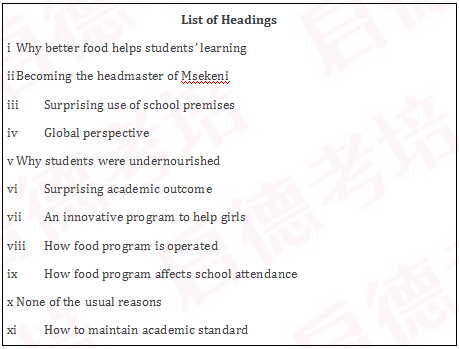
Choose the correct heading for each paragraph from the list of headings below. Write the correct number, i-xi, in boxes 14-20 on your answer sheet.
14 Paragraph A
15 Paragraph B
16 Paragraph C
17 Paragraph D
18 Paragraph E
19 Paragraph F
20 Paragraph G
Tackling Hunger in Msekeni
A. There are not enough classrooms at the Msekeni primary school, so half the lessons take place in the shade of yellow-blossomed acacia trees. Given this shortage, it might seem odd that one of the school’s purpose-built classrooms has been emptied of pupils and turned into a storeroom for sacks of grain. But it makes sense. Food matters more than shelter.
B. Msekeni is in one of the poorer parts of Malawi, a landlocked southern African country of exceptional beauty and great poverty. No war lays waste Malawi, nor is the land unusually crowded or infertile, but Malawians still have trouble finding enough to eat. Half of the children under five are underfed to the point of stunting. Hunger blights most aspects of Malawian life, so the country is as good a place as any to investigate how nutrition affects development, and vice versa.
C. The headmaster at Msekeni, Bernard Kumanda, has strong views on the subject. He thinks food is a priceless teaching aid. Since 1999, his pupils have received free school lunches. Donors such as the World Food Programme (WFP) provide the food: those sacks of grain (mostly mixed maize and soyabean flour, enriched with vitamin A) in that converted classroom. Local volunteers do the cooking— turning the dry ingredients into a bland but nutritious slop, and spooning it out on to plastic plates. The children line up in large crowds, cheerfully singing a song called “We are getting porridge”.
D. When the school’s feeding programme was introduced, enrolment at Msekeni doubled. Some of the new pupils had switched from nearby schools that did not give out free porridge, but most were children whose families had previously kept them at home to work. These families were so poor that the long-term benefits of education seemed unattractive when set against the short-term gain of sending children out to gather firewood or help in the fields. One plate of porridge a day completely altered the calculation. A child fed at school will not howl so plaintively for food at home. Girls, who are more likely than boys to be kept out of school, are given extra snacks to take home.
E. When a school takes in a horde of extra students from the poorest homes, you would expect standards to drop. Anywhere in the world, poor kids tend to perform worse than their better-off classmates. When the influx of new pupils is not accompanied by any increase in the number of teachers, as was the case at Msekeni, you would expect standards to fall even further. But they have not. Pass rates at Msekeni improved dramatically, from 30% to 85%. Although this was an exceptional example, the nationwide results of school feeding programmes were still pretty good. On average, after a Malawian school started handing out free food it attracted 38% more girls and 24% more boys. The pass rate for boys stayed about the same, while for girls it improved by 9.5%.
F. Better nutrition makes for brighter children. Most immediately, well-fed children find it easier to concentrate. It is hard to focus the mind on long division when your stomach is screaming for food. Mr Kumanda says that it used to be easy to spot the kids who were really undernourished. “They were the ones who stared into space and didn’t respond when you asked them questions,” he says. More crucially, though, more and better food helps brains grow and develop. Like any other organ in the body, the brain needs nutrition and exercise. But if it is starved of the necessary calories, proteins and micronutrients, it is stunted, perhaps not as severely as a muscle would be, but stunted nonetheless. That is why feeding children at schools works so well. And the fact that the effect of feeding was more pronounced on girls than on boys gives a clue to who eats first in rural Malawian households. It isn’t the girls.
G. On a global scale, the good news is that people are eating better than ever before. Homo sapiens has grown 50% bigger since the Industrial Revolution. Three centuries ago, chronic malnutrition was more or less universal. Now, it is extremely rare in rich countries. In developing countries, where most people live, plates and rice bowls are also fuller than ever before. The proportion of children under five in the developing world who are malnourished to the point of stunting fell from 39% in 1990 to 30% in 2000, says the World Health Organisation (WHO). In other places, the battle against hunger is steadily being won. Better nutrition is making people cleverer and more energetic, which will help them grow more prosperous. And when they eventually join the ranks of the well-off, they can start fretting about growing too fat.
Questions 21-24
Complete the sentences below using NO MORE THAN TWO WORDS / OR A NUMBER from the passage.
Write your answers in boxes 21-24 on your answer sheet.
21 In Kumanda’s school _________ are given to girls after the end of the school day.
22 Many children from poor families were sent to collect _________ from the field.
23 Thanks to the free food program, ____________ of students passed the test.
24 The modem human is ____________ bigger than before after the Industrial Revolution.
Questions 25-26
Choose TWO letters, A-F.
Write the correct letters in boxes 25 and 26 on your answer sheet.
Which TWO of the following statements are true?
A Some children are taught in the open air.
B Bernard Kumanda became the headmaster in 1991.
C No new staffs were recruited when attendance rose.
D Girls are often treated equally with boys in Malawi.
E Scientists have devised ways to detect the most underfed students in school.
F WHO is worried about malnutrition among kids in developing countries.
参考答案:
14. iii
15. x
16. viii
17. ix
18. vi
19. i
20. iv
21. extra snacks
22. firewood
23. 85%
24. 50%
25. A
26. C
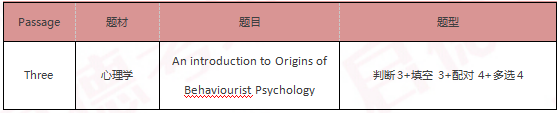
文章大意:
行为心理学的发展,文中给出了几位科学家的研究观点
参考答案:
27. J.Watson believes that brain originates all other activities NO
28. Behaviourist psychologist gave a full explanation for using rats NOT GIVEN
29. Behaviourist psychologists regard changing behaviour as success YES
填空3
30. 待补充
31. Ignored feelings of subjects
32. 待补充
配对4
33. as a result of J Watson work D took place of mental experiences
34. perception and cognition F proved to be difficult to investigate
35. stimulate and response C risked giving misunderstanding
36. A drawback A underestimate human nature
多选4
Four drawbacks mentioned by the author
37. A led to misunderstanding ways of study
38. C ignores the complexities of human
39. E neglects mental experiences
40. F
写作部分
欢迎访问启德考培北京分校 欢迎咨询启德考培学习顾问
免费获取备考提分解决方案,您可以通过以下3种方式联络我们:
1、欢迎致电启德考培客户服务中心400-100-0918;
2、欢迎 点击这里 进行网络咨询;
3、填写表单,我们会在1-3天内为您提供专业的服务。
考试热门工具预约
- 测启德在线学习系统,免费开放预约
- 练丰富题库免费预约试用
- 学0元免费预约公开课
- 评实地测试,老师测评,免费开放预约

雅思口语Part2话题卡怎么准备万能素材
2026/09/18 18:46:04

雅思考试前一周怎么冲刺复习
2026/09/18 18:45:55

雅思G类和A类成绩哪个认可度高
2026/09/18 18:45:47

雅思成绩什么时候提交申请最合适
2026/09/18 18:45:38

雅思口语Part1常见问题及回答思路
2026/09/18 18:45:30

托福成绩可以替代雅思申请英国大学吗
2026/09/18 18:45:21