


听力部分

1 queen
2 double
3 river view
4 West Avenue
5 mirror
6 1.8 metres
7 Tuesday
8 fridge
9 bus stop
10 main road

11. opportunities
12. confidence
13. contacts
14. employees
15. documents
16. promotion
17. 45
18. networking
19. application form
20.self-employment

21-27 配对
21. B
22. G
23. A
24.E
25. C
26. F
27. D
28-30选择
28. B
29. C
30. C

31. salts
32.hospitals
33.slow
34. HealthInternational
35. 9
36. family
37. glass
38. germs
39. 12.5
40. water tank
阅读部分

From A Noviceto An Expert
从新手到专家
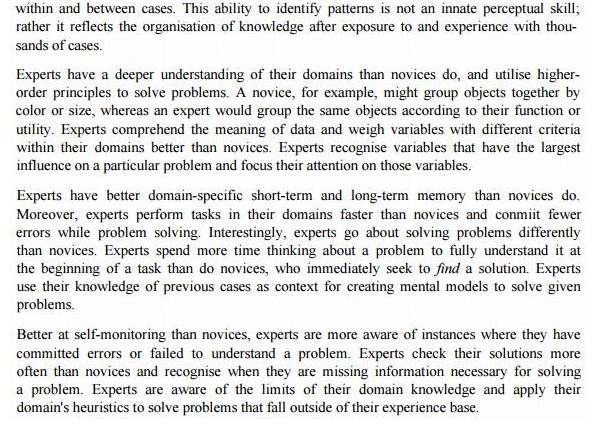
Expertise is commitment coupled with creativity. Specifically, it is thecommitment of time, energy, and resources to a relatively narrow field of studyand the creative energy necessary to generate new knowledge in that field. Ittakes a considerable amount of time and regular exposure to a large number ofcases to become an expert。
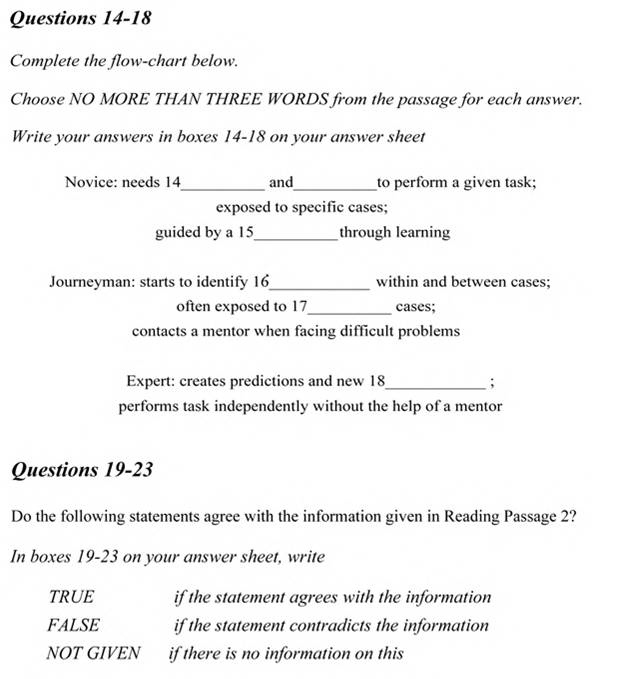
An individual enters a field of study as a novice. The novice needs tolearn the guiding principles and rules of a given task in order to perform thattask. Concurrently; the novice needs to be exposed to specific cases, orinstances, that test the boundaries of such principles. Generally, a novicewill find a mentor to guide her through the process of acquiring new knowledge.A fairly simple example would be someone learning to play chess. The novicechess player seeks a mentor to teach her the object of the game, the number ofspaces, the names of the pieces, the function of each piece, how each piece ismoved, and the necessary conditions for winning or losing the game.
In time, and with much practice, the novice begins to recognise patternsof behavior within cases and, thus, becomes a journeyman. With more practiceand exposure to increasingly complex cases, the journeyman finds patterns notonly within cases but also between cases. More importantly, the journeymanlearns thak these patterns often repeat themselves over time. The journeymanstill maintains regtdar contact with a mentor to solve specific problems andlearn more complex strategies. Returning to the example of the chess player,the individual begins to learn patterns of opening moves, offensive anddefensive game-playing strategies, and patterns of victory and defeat.
When a journeyman starts to make and test hypotheses about futurebehavior based on past experiences, she begins the next transition. Once shecreatively generates knowledge, rather than simply matching superficialpatterns, she becomes an expert. At this point, she is confident in herknowledge and no longer needs a mentor as a guide—she becomes responsible forher own knowledge. In the chess example, once a journeyman begins competingagainst experts, makes predictions based on patterns, and tests thosepredictions against actual behavior, she is generating new knowledge and adeeper understanding of the game. She is creating her own cases rather thanrelying on the cases of others.
The Power of Expertise
An expert perceives meaningful patterns in her domain better thannon-experts. Where a novice perceives random or disconnected data points, anexpert connects regular patterns
*以下题目题号应为1-13
参考答案
填空题
1. Guiding principles; rules
2. Mentor
3. Patterns of behaviour
4. Complex
5. Test
判断题
6. FALSE
7. NOT GIVEN
8. TRUE
9. TRUE
10.TRUE
填空题
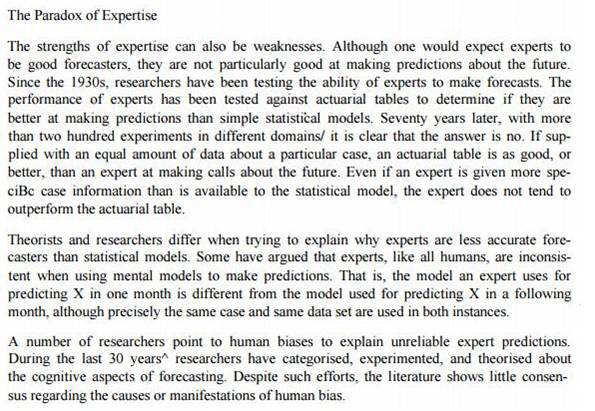
11.Experiments
12.Human bias
13.Consensus

参考原文
Fossilfiles “ThePaleobiology Database”
A
Are wenow living through the sixth extinction as our own activities destroy
ecosystemsand wipe out diversity? That’s the doomsday scenario painted
by manyecologists, and they may well be right. The trouble is we don’t
know forsure because we don’t have a clear picture of how life changes
betweenextinction events or what has happened in previous episodes. We
don’t even knowhow many species are alive today, let alone the rate at which
they arebecoming extinct. A new project aims to fill some of the gaps. The
PaleobiologyDatabase aspires to be an online repository of information about
everyfossil ever dug up. It is a huge undertaking that has been described as
biodiversity’s equivalentof the Human Genome Project. Its organizers hope
that byrecording the history of biodiversity they will gain an insight into how
environmentalchanges have shaped life on Earth in the past and how they
might doso in the future. The database may even indicate whether life can
reboundno matter what we throw at it, or whether a human induced extinction
could bewithout parallel, changing the rules that have applied throughout the
rest ofthe planet’s history.
B
Butalready the project is attracting harsh criticism. Some experts believe it
to beseriously flawed. They point out that a database is only as good as the
data fedinto it, and that even if all the current fossil finds were catalogued,
theywould provide an incomplete inventory of life because we are far from
discoveringevery fossilised species. They say that researchers should get up
fromtheir computers and get back into the dirt to dig up new fossils. Others
are moresceptical still, arguing that we can never get the full picture because
thefossil record is riddled with holes and biases.
C
Fans ofthe Paleobiology Database acknowledge
that thefossil record will always be incomplete.
But theysee value in looking for global patterns
thatshow relative changes in biodiversity.
“The fossil record is the best tool we have for
understandinghow diversity and extinction work in normal times,” says John
Alroyfrom the National Center for Ecological Analysis and Synthesis in Santa
Barbara.“Having a background extinction estimate gives us abenchmark for
understandingthe mass extinction that’s currently under way. It allows us to
say justhow bad it is in relative terms.”
D
To thisend, the Paleobiology Database aims to be the most thorough attempt
yet tocome up with good global diversity curves. Every day between 10
and 15scientists around the world add information about fossil finds to the
database.Since it got up and running in 1998, scientists have entered almost
340,000specimens, ranging from plants to whales to insects to dinosaurs to
seaurchins. Overall totals are updated hourly at www.paleodb.org. Anyone
candownload data from the public part of the site and play with the numbers
to theirheart’s content. Already, the database has thrown up somesurprising
results.Looking at the big picture, Alroy and his colleagues believe they
havefound evidence that biodiversity reached a plateau long ago, contrary
to thereceived wisdom that species numbers have increased continuously
betweenextinction events. “The traditional view is that diversity has gone up
and upand up,” he says. “Our research is showing that diversity limits were
approachedmany tens of millions of years before the dinosaurs evolved, much
lesssuffered extinction.” This suggests that only a certain number of species
can liveon Earth at a time, filling a prescribed number of niches like spaces
in amulti-storey car park. Once it’s full, no more new species can squeeze in,
untilextinctions free up new spaces or something rare and catastrophic adds a
newfloor to the car park.
E
Alroyhas also used the database to reassess the accuracy of species names.
Hisfindings suggest that irregularities in classification inflate the overall
numberof species in the fossil record by between 32 and 44 per cent. Single
speciesoften end up with several names, he says, due to misidentification or
poorcommunication between taxonomists in different countries. Repetition
likethis can distort diversity curves. “If you have really bad taxonomy in one
shortinterval, it will look like a diversity spike~a big diversification followed
by a bigextinction—when all that has happened is a change in the quality
ofnames,” says Alroy. For example, his statistical analysisindicates that of
the 4861North American fossil mammal species catalogued in the database,
between24 and 31 per cent will eventually prove to be duplicates.
F
Ofcourse, the fossil record is undeniably patchy (adj. 不协调的). Some laces
andtimes have left behind more fossil-filled rocks than others. Some have
beensampled more thoroughly. And certain
kinds ofcreatures— those with hard parts
thatlived in oceans, for example— are
morelikely to leave a record behind, while
others,like jellyfish, will always remain a
mystery.Alroy has also tried to account for
this. Heestimates, for example, that only
41 percent of North American mammals
thathave ever lived are known from fossils,
and hesuspects that similar proportion of
fossilsare missing from other groups, such
as fungiand insects .
G
Noteveryone is impressed with such mathematical wizardry (n. 魔法).
onathanAdrain from the University of Iowa in Iowa City points out that
statisticalwrangling ( 争吵) has been known to create mass extinctions where
noneoccurred. It is easy to misinterpret data. For example, changes in sea level
orinconsistent sampling methods can mimic major changes in biodiversity.
Indeed,a recent and thorough examination of the literature on marine bivalve
fossilshas convinced David Jablonsky from the University of Chicago and his
colleaguesthat their diversity has increased steadily over the past 5 million
years .
H
Adrainbelieves that fancy analytical techniques are no substitute for hard
evidence,but he has also seen how inadequate historical collections can be.
When hestarted his ongoing study of North American fossils from the Early
Ordovician,about 500 million years ago, the literature described one genus and
fourspecies of trilobites, lust by going back to the fossil beds and sampling
morethoroughly, Adrain found 11 genera and 39 species. “Lookinginward
hasmaybe taken us as far as it’s going to take us,” he says. “There’s an awful
lot moreout there than is in the historical record.” The only way to really get
at thehistory of biodiversity, say Adrain and an increasingly vocal group of
scientists,is to get back out in the field and collect new data.
I
With aninventory of all living species, ecologists could start to put the current
biodiversitycrisis in historical perspective. Although creating such a list would
be atask to rival even the Palaeobiology Database, it is exactly what the San
Francisco-basedALL Species Foundation hopes to achieve in the next 25
years.The effort is essential, says Harvard biologist Edward O. Wilson, who
isalarmed by current rates of extinction. “There is a crisis. We’ve begun to
measureit, and it’s very high,” Wilson says. “We need this kind of information
in muchmore detail to protect all of biodiversity, not just the ones we know
well.” Let thecounting continue.
参考答案:
段落大意配对题
14. Vi AJ这个教授认为这个database第一个缺点是有很多重复性词条
15. I. database的介绍
16. Vii. AJ这个教授认为这个database第二个缺点,地球上有很多地方比如说海底,还没有被探索
17. Ii. 一些人很支持这个database,认为对未来寻找新物种很有帮助
18. Iv. 关于jellyfish的化石比较少的原因,因为是软体动物,几乎没有骨骼
19. Viii. 对这个database的未来的plans
20. Iii. 这个database的好处,它有5百万份样品
多选
AJ这个教授认为这个database不太可靠的原因
21. B. 有很多重复词条
22. D. 地球上还有大量生物未被发现和鉴定
作者观点配对
23. E. 第一个J教授他认为应该收集更多的化石
24. A. AJ认为我们应该清除一些重复词条
25. C. MS对这个数据库的未来非常看好
26. B. RL对数据库的未来表示不太看好

参考原文:
When most of us hear the word chocolate, we picture a bar, a box ofbonbons1), or a bunny2). The verb that comes to mind is probably"eat", not "drink", and the most apt3) adjective would seemto be "sweet". But for about 90 percent of chocolate's long history,it was strictly a beverage, and sugar didn't have anything to do withit. "I often call chocolate the best-known food that nobody knowsanything about," said Alexandra Leaf, a self-described "chocolateeducator" who runs a business called Chocolate Tours of New YorkCity.
Theterminology can be a little confusing, but most experts these days use the term"cacao" to refer to the plant or its beans before processing4), whilethe term "chocolate" refers to anything made from the beans."Cocoa" generally refers to chocolate in a powdered form, although itcan also be a British form of "cacao". Etymologists5) trace theorigin of the word "chocolate" to the Aztec6) word"xocoatl", which referred to a bitter drink brewed from cacao beans.The Latin name for the cacao tree, Theobroma cacao, means "food of thegods". Many modern historians have estimated that chocolate has beenaround for about 2000 years, but recent research suggests that it may be evenolder. In the book The True History of Chocolate, authors Sophie andMichael Coe make a case7) that the earliest linguistic evidence of chocolateconsumption stretches back three or even four millennia8), to pre-Columbiancultures of Mesoamerica9) such as the Olmec10).
LastNovember, anthropologists from the University of Pennsylvania announced thediscovery of cacao residue11) on pottery excavated in Honduras12) that coulddate back as far as 1400 B.C.E. It appears that the sweet pulp13) of the cacaofruit, which surrounds the beans, was fermented14) into an alcoholic beverageof the time. "Who would have thought, looking at this, that you caneat it?" said Richard Hetzler, executive chef of the café at theSmithsonian's National Museum of the American Indian, as he displayed a freshcacao pod15) during a recent chocolate-making demonstration. "You wouldhave to be pretty hungry, and pretty creative!"
It's hard topin down16) exactly when chocolate was born, but it's clear that it wascherished from the start. For several centuries in pre-modern Latin America,cacao beans were considered valuable enough to use as currency. One bean couldbe traded for a tamale17), while 100 beans could purchase a good turkey hen,according to a 16th-century Aztec document.
Both theMayans and Aztecs believed the cacao bean had magical, or even divine,properties18), suitable for use in the most sacred19) rituals of birth,marriage and death. According to Chloe Doutre-Roussel's book The ChocolateConnoisseur20), Aztec sacrifice victims who felt too melancholy21) to join in ritualdancing before their death were often given a gourd of chocolate (tinged withthe blood of previous victims) to cheer them up.
Sweetenedchocolate didn't appear until Europeans discovered the Americas and sampled thenative cuisine. Legend has it that the Aztec king Montezuma22) welcomed theSpanish explorer Hernando Cortés with a banquet that included drinkingchocolate, having tragically mistaken him for a reincarnated23) deity insteadof a conquering invader. Chocolate didn't suit the foreigners' taste buds24) atfirst—one described it in his writings as "a bitter drink forpigs"—but once mixed with honey or cane sugar, it quickly became popularthroughout Spain.
By the 17thcentury, chocolate was a fashionable drink throughout Europe, believed to havenutritious, medicinal and even aphrodisiac25) properties. But it remainedlargely a privilege of the rich until the invention of the steam engine mademass production possible in the late 1700s.
In 1828, aDutch chemist found a way to make powdered chocolate by removing about half thenatural fat (cacao butter) from chocolate liquor, pulverizing26) what remainedand treating the mixture with alkaline27) salts to cut the bitter taste. Hisproduct became known as "Dutch cocoa", and it soon led to the creationof solid chocolate.
The creationof the first modern chocolate bar is credited to Joseph Fry, who in 1847discovered that he could make a moldable chocolate paste by adding melted cacaobutter back into Dutch cocoa. By 1868, a little company called Cadbury wasmarketing boxes of chocolate candies in England. Milk chocolate hit the marketa few years later, pioneered28) by another name that may ring abell29)—Nestle.
In America,chocolate was so valued during the Revolutionary War30) that it was included insoldiers' rations31) and used in lieu of32) wages. While most of us probablywouldn't settle for33) a chocolate paycheck these days, statistics show thatthe humble cacao bean is still a powerful economic force. Chocolatemanufacturing is a more than 4-billion-dollar industry in the United States,and the average American eats at least half a pound of the stuff permonth.
In the 20thcentury, the word "chocolate" expanded to include a range ofaffordable treats with more sugar and additives34) than actual cacao in them,often made from the hardiest but least flavorful of the beanvarieties. But more recently, there's been a "chocolaterevolution," Leaf said, marked by an increasing interest in high-quality,handmade chocolates and sustainable, effective cacao farming and harvestingmethods. Major corporations like Hershey's have expanded their artisanal35)chocolate lines by purchasing smaller producers known for premium36)chocolates, such as Scharffen Berger and Dagoba, while independent chocolatierscontinue to flourish as well.
参考答案:
段落细节配对
27. FALSE可可起源于非洲(应该是美洲的墨西哥)
28. TRUE在欧洲,人们一开始喝巧克力是当药来喝
29. TRUE政治对巧克力的传播和普及有很大影响(正确,因为法国大革命之后,茶和咖啡酒取代了喝巧克力)
30. TRUE第一个大规模生产的是美国公司Hershey
段落配对
31. F近代巧克力的大规模生产
32. D在欧洲一开始都是贵族喝的
33. C西班牙殖民者带回到了欧洲
34. A这段介绍可可的起源,起源于中美洲,之后传到南美洲,然后到欧洲
35. B可可在起源地的药用特性,人们喝巧克力是当药喝的
句子填空
36. England是欧洲少数国家,巧克力不仅仅局限于宫廷人士的饮用,普通人也可以喝到
37. 法国文化大革命之后,coffee and tea取代了巧克力成为受欢迎的饮品
38. Milk的加入使固态巧克力成为受欢迎的零食
39. 美国MiltonHershey公司使巧克力大规模生产
40. 大规模生产的坏处就是导致了巧克力quality下降
以上就是启德小编为大家介绍的9月21日雅思考题回顾内容,希望可以帮助大家更好了解掌握雅思考试内容。如果想了解更多关于雅思写作如何提升及相关信息,请关注启德考培上海徐汇分校平台,免费获取备考提分解决方案,或欢迎 点击这里 进行网络咨询,我们会给您提供专业的服务。最后,预祝大家雅思考试能取得理想的成绩。
考试热门工具预约
- 测启德在线学习系统,免费开放预约
- 练丰富题库免费预约试用
- 学0元免费预约公开课
- 评实地测试,老师测评,免费开放预约

雅思成绩可以用来考研保研吗?用途大盘点
2026/09/20 18:20:47

雅思写作跑题怎么避免?审题3步法
2026/09/20 18:20:39

雅思目标7分要准备多久?分数目标拆解方法
2026/09/20 18:20:31

雅思备考效率低怎么破?4个常见误区
2026/09/20 18:20:23

雅思写作Task1怎么开头?范文结构拆解
2026/09/20 18:20:15

托福自学还是报班?3个标准帮你判断
2026/09/20 18:20:07