


可爱的烤鸭们,还记得12月9日雅思考题吗?我知道,我都知道,你们一定忘记。follow启德考培小编一起回顾真题吧。
听力部分

1. training
2.supermarket
3. uniform
4. furniture
5. night
6. variable
7. reliable
8. school
9. keyboard
10. transport

11-16 选择
11. C
12. B
13. C
14. A
15. C
16. A
17-20 地图
17. F
18. H
19.A
20. G

21-26 选择
21. C
22. B
23. C
24. C
25.C
26. A
27-30 配对
27. C
28. E
29.C
30. E

31. money
32. liquid
33. sugar
34. mood
35. Italy
36. solid
37. shops
38. labor
39. economy
40. coast
阅读部分

参考文章:
Alfred Nobel
The man behind the Nobel Prize
A Since 1901, the Nobel Prize has been honoring men and women from all comers of the globe for outstanding achievements in physics, chemistry, medicine, literature, and for work in peace. The foundations for the prize were laid in 1895 when Alfred Nobel wrote his lost will, leaving much of his wealth to the establishment of the Nobel Prize.
B Alfred Nobel was born in Stockholm on October 21. 1833. His father Immanuel Nobel was an engineer and inventor who built bridges and buildings in Stockholm. In connection with his construction work Immanuel Nobel also experimented with different techniques for blasting rocks. Successful in his industrial and business ventures, Immanuel Nobel was able, in 1842, to bring his family to St. Petersburg. There, his sons were given a first-class education by private teachers. The training included natural sciences, languages and literature. By the age of 17 Alfred Nobel was fluent in Swedish, Russian, French, English and German. His primary interests were in English literature and poetry as well as in chemistry and physics. Alfred's father, who wanted his sons to join his enterprise as engineers, disliked Alfred's interest in poetry and found his son rather introverted.
C In order to widen Alfred's horizons his father sent him abroad for further training in chemical engineering. During a two year period Alfred Nobel visited Sweden, Germany. France and the United States. In Paris, the city he came to like best, he worked in the private laboratory of Professor T. J. Pelouze, a famous chemist. There he met the young Italian chemist Ascanio Sobrero who, three years earlier, had invented nitroglycerine, a highly explosive liquid. But it was considered too dangerous to be of any practical use. Although its explosive power greatly exceeded that of gunpowder, the liquid would explode in a very unpredictable manner if subjected to heat and pressure. Alfred Nobel became very interested in nitroglycerine and how it could be put to practical use in construction work. He also realized that the safety problems had to be solved and a method had to be developed for the controlled detonation of nitroglycerine.
D After his return to Sweden in 1863, Alfred Nobel concentrated on developing nitroglycerine as an explosive. Several explosions, including one (1864) in which his brother Kmil and several other persons were killed, convinced the authorities that nitroglycerine production was exceedingly dangerous. They forbade further experimentation with nitroglycerine within the Stockholm city limits and Alfred Nobel had to move his experimentation to a barge anchored on Lake Malaren. Alfred was not discouraged and in 1864 he was able to start mass production of nitroglycerine. To make the handling of nitroglycerine safer Alfred Nobel experimented with different additives. He soon found that mixing nitroglycerine with kieselguhr would turn the liquid into a paste which could be shaped into rods of a size and form suitable for insertion into drilling holes. In 1867 he patented this material under die name of dynamite. To be able to detonate the dynamite rods he also invented a detonator (blasting cap) which could be ignited by lighting a fuse. These inventions were made at the same time as the pneumatic drill came into general use. Together these inventions drastically reduced the cost of blasting rock, drilling tunnels, building canals and many other forms of construction work.
E The market for dynamite and detonating caps grew very rapidly and Alfred Nobel also proved himself to be a very skillful entrepreneur and businessman. Over the years he founded factories and laboratories in some 90 different places in more than 20 countries. Although he lived in Paris much of his life he was constantly traveling. When he was not traveling or engaging in business activities Nobel himself worked intensively in his various laboratories, first in Stockholm and later in other places. He focused on the development of explosives technology as well as other chemical inventions, including such materials as synthetic rubber and leather, artificial silk, etc. By the time of his death in 18% he had 355 patents.
F Intensive work and travel did not leave much time for a private life. At the age of 43 he was feeling like an old man. At this time he advertised in a newspaper “Wealthy, highly-educated elder gentleman seeks lady of mature age, versed in languages, as secretary and supervisor of household." The most qualified applicant turned out to be an Austrian woman. Countess Bertha Kinsky. After working a very short time for Nobel she decided to return to Austria to marry Count Arthur von Suttner. In spite of this Alfred Nobel and Bertha von Suttner remained friends and kept writing letters to each other for decades. Over the years Bertha von Suttner became increasingly critical of the arms race. She wrote a famous book, Lay Down Your Arms and became a prominent figure in the peace movement. No doubt this influenced Alfred Nobel when he wrote his final will which was to include a Prize for persons or organizations who promote peace. Several years after the death of Alfred Nobel, the Norwegian Storting (Parliament) decided to award the 1905 Nobel Peace Prize to Bertha von Suttner.
G Alfred Nobel died in San Remo, Italy, on December 10, 1896. When his will was opened it came as a surprise that his fortune was to be used for Prizes in Physics, Chemistry. Physiology or Medicine, Literature and Peace. The executors of his will were two young engineers, Ragnar Sohlman and Rudolf Lilljequist. They set about forming the Nobel Foundation as an organization to take care of the financial assets left by Nobel for this purpose and to coordinate the work of the Prize-Awarding Institutions. This was not without its difficulties since the will was contested by relatives and questioned by authorities in various countries.
H Alfred Nobel's greatness lay in his ability to combine the penetrating mind of the scientist and inventor with the forward-looking dynamism of the industrialist. Nobel was very interested in social and peace-related issues and held what were considered radical views in his era. He had a great interest in literature and wrote his own poetry and dramatic works. The Nobel Prizes became an extension d a fulfillment of his lifetime interests.
参考答案:
判断题:
1. The first Nobel Prize was awarded in 1895. FALSE
2. Nobel's father wanted his son to have better education than what he had had. NOT GIVEN
3. Nobel was an unsuccessful businessman. FALSE
4. Bertha von Suttner was selected by Nobel himself for the first peace prize. FALSE
5. The Nobel Foundation was established after the death of Nobel. TRUE
6. Nobel's social involvement was uncommon in the 1800’s. TRUE
填空题:
7. chemical engineering
8. Ascanio Sobrero
9. gunpowder
10. Stockholm
11. detonator
12. pneumatic drill
13. cost
(答案仅供参考)
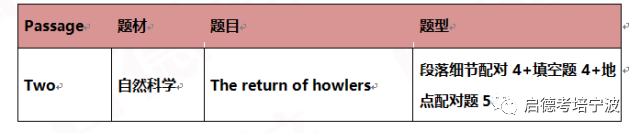
参考文章:
A
AS AN EAST WIND blasts through a gap in the Cordillera de Tilaran, a rugged mountain range that splits northern Costa Rica in half, a female mantled howler monkey moves through the swaying trees of the forest canopy.
B
Ken Glander,a primatologist from Duke University, gazes into the canopy, tracking the female's movements. Holding a dart gun, he waits with infinite patience for the right moment to shoot. With great care, Glander aims and fires. Hit in the rump, the monkey wobbles. This howler belongs to a population that has lived for decades at Hacienda La Pacifica, a working cattle ranch in Guanacaste province. Other native primates — white-faced capuchin monkeys and spider monkeys — once were common in this area, too, but vanished after the Pan-American Highway was built nearby in the 1950s. Most of the surrounding land was clear-cut for pasture.
C
Howlers persist at La Pacifica, Glander explains, because they are leaf-eaters. They eat fruit, when it’s available but, unlike capuchin and spider monkeys, do not depend on large areas of fruiting trees. Howlers can survive anyplace you have half a dozen trees, because their eating habits are so flexible,’,he says. In forests, life is an arms race between trees and the myriad creatures that feed on leaves. Plants have evolved a variety of chemical defenses, ranging from bad-tasting tannins, which bind with plant-produced nutrients, rendering them indigestible, to deadly poisons, such as alkaloids and cyanide.
D
All primates, including humans, have some ability to handle plant toxins. “We can detoxify a dangerous poison known as caffeine, which is deadly to a lot of animals:" Glander says. For leaf-eaters, long-term exposure to a specific plant toxin can increase their ability to defuse the poison and absorb the leaf nutrients. The leaves that grow in regenerating forests, like those at La Pacifica, are actually more howler friendly than those produced by the undisturbed, centuries-old trees that survive farther south, in the Amazon Basin. In younger forests, trees put most of their limited energy into growing wood, leaves and fruit, so they produce much lower levels of toxin than do well- established, old-growth trees.
E
The value of maturing forests to primates is a subject of study at Santa Rosa National Park, about 35 miles northwest of Hacienda La Pacifica. The park hosts populations not only of mantled howlers but also of white-faced capuchins and spider monkeys. Yet the forests there are young, most of them less than 50 years old. Capuchins were the first to begin using the reborn forests, when the trees were as young as 14 years. Howlers, larger and heavier than capuchins, need somewhat older trees, with limbs that can support their greater body weight. A working ranch at Hacienda La Pacifica also explain their population boom in Santa Rosa. “Howlers are more resilient than capuchins and spider monkeys for several reasons,” Fedigan explains. “They can live within a small home range, as long as the trees have the right food for them. Spider monkeys, on the other hand, occupy a huge home range, so they can’t make it in fragmented habitat.”
F
Howlers also reproduce faster than do other monkey species in the area. Capuchins don’t bear their first young until about 7 years old, and spider monkeys do so even later, but howlers give birth for the first time at about 3.5 years of age. Also, while a female spider monkey will have a baby about once every four years, well-fed howlers can produce an infant every two years.
G
The leaves howlers eat hold plenty of water, so the monkeys can survive away from open streams and water holes. This ability gives them a real advantage over capuchin and spider monkeys, which have suffered during the long, ongoing drought in Guanacaste.
H
Growing human population pressures in Central and South America have led to persistent destruction of forests. During the 1990s, about 1.1 million acres of Central American forest were felled yearly. Alejandro Estrada, an ecologist at Estacion de Biologia Los Tuxtlas in Veracruz, Mexico, has been exploring how monkeys survive in a landscape increasingly shaped by humans. He and his colleagues recently studied the ecology of a group of mantled howler monkeys that thrive in a habitat completely altered by humans: a cacao plantation in Tabasco, Mexico. Like many varieties of coffee, cacao plants need shade to grow, so 40 years ago the landowners planted fig, monkey pod and other tall trees to form a protective canopy over their crop. The howlers moved in about 25 years ago after nearby forests were cut. This strange habitat, a hodgepodge of cultivated native and exotic plants, seems to support about as many monkeys as would a same-sized patch of wild forest. The howlers eat the leaves and fruit of the shade trees, leaving the valuable cacao pods alone, so the farmers tolerate them.
I
Estrada believes the monkeys bring underappreciated benefits to such farms, dispersing the seeds of fig and other shade trees and fertilizing the soil with feces. He points out that howler monkeys live in shade coffee and cacao plantations in Nicaragua and Costa Rica as well as in Mexico. Spider monkeys also forage in such plantations, though they need nearby areas of forest to survive in the long term. He hopes that farmers will begin to see the advantages of associating with wild monkeys, which includes potential ecotourism projects.
J
"Conservation is usually viewed as a conflict between agricultural practices and the need to preserve nature, “ Estrada says. ''We 're moving away from that vision and beginning to consider ways in which agricultural activities may become a tool for the conservation of primates in human-modified landscapes. “
参考答案:
段落细节配对:
14. C
15. G
16. C
17. B
填空题:
18. reproduction
19. fruit
20. toxins
21. drought
地点配对:
22. B
23. A
24. C
25. B
26. A
(文章及答案仅供参考)
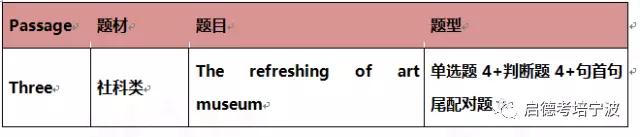
参考答案:
单选题:
27. D
28. B
29. C
30. B
判断题:
31. NO
32. NO
33. NOT GIVEN
34. NOT GIVEN
35. YES
句首句尾配对题:
36. F
37. E
38. C
39. B
40. D
(答案仅供参考)
12月9日雅思考试写作考官范文
A rise in living standards seems to benefit people in cities only, rather than those in rural areas. What problems can it cause? How can these problems be solved?
As economic development has accelerated in parts of the developing world, national GDP levels have risen simultaneously. However, GDP is not an accurate measure of how income is distributed across a country. Clearly, not everyone in the developing world has benefited from increased growth, with wealth disparities rife across many nations. This is particularly stark when making comparisons between urban and rural areas.
One of the biggest problems of wealth inequality is the potential for social unrest. If large sections of the population feel their needs are not being met, social turmoil becomes an ever-growing threat. This puts pressure on governments to maintain a balance between sustainable growth and maintaining domestic order. Additionally, wealth inequality can be a self-reinforcing problem. Rural parts of the country that are neglected tend to go into perpetual downward spirals, starved of opportunity and investment. Once this happens, private capital will not be invested in these areas, as entrepreneurs would reasonably conclude that such places do not have growth potential.
Wealth inequality is surely on of the greatest challenge facing governments and policy makers across the globe. Only a coordinated, international response to this problem will suffice. Governments must acknowledge that the private sector and the free market do not provide the most effective way to deliver opportunity and growth in some sectors. With regard to housing, infrastructure and public services, governments must be prepared to invest and deliver these essentials to the population.
Wealth inequality cannot be tackled by the free market: that much is clear. Thus, a more interventionist approach must be taken by governments to address this challenge. Public money must be invested in areas of greatest need and the richest in society must bear a higher tax burden.
Timothy Williams
以上为2017年12月9日雅思试题回顾及解析+范文,如果想了解更多关于雅思口语如何提升及相关信息,请关注启德考培宁波分校平台,免费获取备考提分解决方案,或欢迎 点击这里 进行网络咨询,我们会给您提供专业的服务。最后,预祝大家雅思考试能取得理想的成绩。
考试热门工具预约
- 测启德在线学习系统,免费开放预约
- 练丰富题库免费预约试用
- 学0元免费预约公开课
- 评实地测试,老师测评,免费开放预约

雅思口语Part2话题卡怎么准备万能素材
2026/09/18 18:46:04

雅思考试前一周怎么冲刺复习
2026/09/18 18:45:55

雅思G类和A类成绩哪个认可度高
2026/09/18 18:45:47

雅思成绩什么时候提交申请最合适
2026/09/18 18:45:38

雅思口语Part1常见问题及回答思路
2026/09/18 18:45:30

托福成绩可以替代雅思申请英国大学吗
2026/09/18 18:45:21