









参考文章
Surprising History of New Zealand Films
The release of the first of Sir Peter Jackson's three The Lord of the Rings films 10 years ago changed how the world viewed New Zealand as a film-making nation.
While for decades New Zealand had produced world-class directors and actors - and a handful of internationally acclaimed films - The Lord of the Rings showed we could also make Hollywood-style blockbusters.
But there's been another significant achievement for New Zealand film since The Lord of the Rings that people would be less aware of, and one that Frank Stark, co-editor of a new book, New Zealand Film: An Illustrated History, points out. In the 115-year history of film in this country, more than half of all our feature films were made in just the past 10 years, he says. "That's a tribute to how much we've entered the world in technology," he says.
But, as the book, co-edited with Diane Pivac and Lawrence McDonald, shows over that 115 years New Zealanders were always busy making films, it just wasn't that many features.
"There were real blocks, both in [our] national psyche and marketing, to actually make feature films here, so people got out and made every other imaginable film. So many of those people really dreamed of being able to make full length feature films and weren't able to."
The book, with contributions from 24 writers, covers everything from the first public motion picture screening in 1896 (Auckland on October 13, Wellington on October 28) to last year's hit Boy, our most popular New Zealand-set film.
One of the first advertised screenings of a film shot in New Zealand was in 1898 of the opening by the governor of the Auckland Industrial and Mining Exhibition.
Stark says in looking at the early days of New Zealand film-making he has seen a double standard "in the best sense". "One is just that slight sense of astonishment that they got made at all in some cases, like Rudall Hayward who was developing films in his bath. But the other level is when you look at something like The Te Kooti Trail [1927] and put it up against Hollywood, he [Hayward] didn't have access to professional actors, which is probably one of the most telling differences. "But even so, those films of the 1920s, if only they could have got out of the country and be seen, they would have had an international audience. They would have been really well thought of anywhere in the world."
Stark, a film maker himself and head of the New Zealand Film Archive in Wellington, says one reason the book does cover a lot about early films is because of the research and discoveries that have been made in recent years. The archive marks its 30th birthday this year.
"The heart of it all is the actual fact that those films still exist. The story would be esoteric at best if the films weren't there to back it up.
"That's the great achievement of the archive in 30 years - bringing so many of those films back from the brink or from the deep cupboard in which they'd been forgotten about."
New Zealand Film: An Illustrated History is not the first book to examine the history of New Zealand film, nor is it likely to be the last. But An Illustrated History is touted as the most ambitious.
"There was a real sense that none [of the other books] really went for the whole picture.
"It's been some years since any kind of overview's been published, so the recent activity wasn't put in context [and] also those first 50 or 60 years hadn't been laid out either. We wanted to put the whole spectrum in there," says Stark.
He's also proud of the book's special feature - the inclusion of a 90-minute DVD from the archive, drawn from the thousands of hours in the vaults.
It includes scenes from films on DVD for the first time.
There is a wealth of information, interpretation and opinion in the book.
The first New Zealanders known to be captured on film? It included prime minister John Seddon and it was shot during Queen Victoria's Diamond Jubilee celebratory service in 1897. Geoff Murphy's Utu (1983) on the New Zealand wars is considered a breakthrough film for portraying Maori and Pakeha with tough-minded realism and giving equal attention to Maori and Pakeha characters.
There's also the observation that many New Zealand films - and our literature - are about adolescence or a rite of passage. One theory is that adolescence is a natural theme for a young country. Another theory is that youth is the most intense period in the life of New Zealanders, despite living, by world standards, in a very peaceful country.
There are other eye-openers. While Boy made $9.3 million at the box office, making it our biggest-grossing film, Once Were Warriors, which made more than $7m in 1994, was seen by more people. It sold more than one million tickets, compared - in part due to ticket price increases - with more than 845,000 for Boy. The average price for a movie ticket in 1980 was $2.39 ($10 in 2010 dollars). Today the average price is $15.
And while Jackson's most recent films, while shot here, haven't been set in New Zealand or tell New Zealand stories, the book doesn't ignore their impact or Jackson's significance in the history of New Zealand film.
Writer and film academic Roger Horrocks warns that despite our achievements, our film industry is small by world standards. Jackson makes a big difference, he writes. "His big budget area of the industry could disappear if this one-of-a-kind film-maker moved overseas, retired or had a run of box office disasters."
Horrocks also points out that essentially film-makers today face some of the same problems of Hayward in the 1920s - the size of the New Zealand market. In other countries, film-makers can try to cover their costs with home audiences, then make a profit overseas.
"But the size of our population makes that very difficult."
参考答案:暂缺
EIC-2018年01月13日雅思考试考官范文
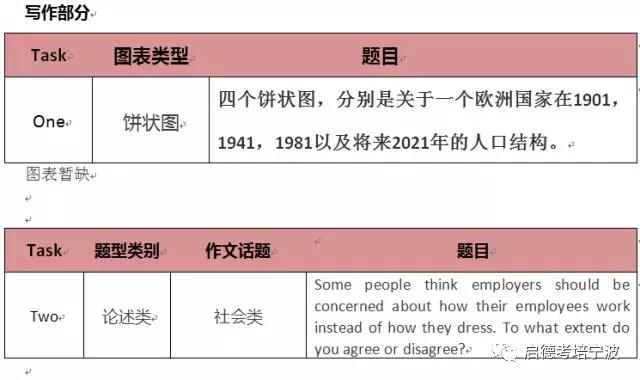
Some people think employers should be concerned about how their employees work instead of how they dress. To what extent do you agree or disagree?
By Timothy Williams
Dress codes have long been an important aspect of company policy for many organisations. Ensuring staff are well presented is integral to the image of a good business. Nonetheless, in recent years, many companies have relaxed their requirements regarding dress in order to give employees a greater sense of freedom. On the whole, I think this is a good thing.
Traditionally, men and women were expected to go to work in outfits that reflected a business-like demeanour. Men were expected to wear suits and ties, while women wore dresses or blouses. In many respects, the uniformity of dress maintained a sense of order and discipline within a company. Nonetheless, it isn’t necessarily the case that workers produce better quality work in a more efficient manner simply because they obey a dress code.
Nowadays, more and more companies have a relaxed dress code, allowing employees to wear what they want, so long as it is within reason. The thinking behind this is that giving people more autonomy over their appearance and working habits will encourage them to be more creative and independently minded. Additionally, many companies now operate with flexible working hours, allowing people to work at home in a manner that suits them. People can only flourish when they feel they have control over their appearance and schedule.
As far as I am concerned, employers should focus exclusively on the quality of work produced by their employees, and should regard their dress as a minor matter. Undoubtedly, company dress codes should be a thing of the past.
如果想了解更多关相关信息,请关注启德考培宁波分校平台,免费获取备考提分解决方案,或欢迎 点击这里 进行网络咨询,我们会给您提供专业的服务。最后,预祝大家能在托福考试中取得理想中的成绩。
考试热门工具预约
- 测启德在线学习系统,免费开放预约
- 练丰富题库免费预约试用
- 学0元免费预约公开课
- 评实地测试,老师测评,免费开放预约

雅思成绩可以用来考研保研吗?用途大盘点
2026/09/20 18:20:47

雅思写作跑题怎么避免?审题3步法
2026/09/20 18:20:39

雅思目标7分要准备多久?分数目标拆解方法
2026/09/20 18:20:31

雅思备考效率低怎么破?4个常见误区
2026/09/20 18:20:23

雅思写作Task1怎么开头?范文结构拆解
2026/09/20 18:20:15

托福自学还是报班?3个标准帮你判断
2026/09/20 18:20:07