


听力部分
Section | 版本号 | 场景 | 题型 |
One | 旧 | 对话 | 填空10 |
内容概述:旅游咨询,关于罂粟花的参观咨询。此部分难度较低,考生应尽量全对。
1.month
2.orange
3.east
4.state
5.trousers
6.general
7.1 hour
8.museum
9.5:30
10.zoom
Section | 版本号 | 场景 | 题型 |
Two | 旧 | 介绍 | 选择4+地图6 |
内容概述:对于当地广播台的介绍,有常见的local news program,还有musical program,以及最新推出的语言学习节目。此部分地图题难度稍大,考生仍需注意地图题类型的练习。
参考答案:
选择题:
11.C language program
12.C organizational skill
13.A involve in the community
14.A caravan
地图题:
15.E cafe
16.B storeroom
17.A training studio
18.F main control
19.G studio
20.H
Section | 版本号 | 场景 | 题型 |
Three | 旧 | 对话 | 单选6+多选4 |
内容概述:两个学生讨论语言学的课题。据考生反应这部分难度稍大,尤其是多选题,考生需要提高审题能力,同时提高听力能力。
参考答案:
单选题:
21.B cameras in every room
22.C related to the researcher
23.C have no impact
24.C have wilder application
25.B
26.C learn words and phrases
多选题:
使用的调查方法是:
27.C dairy
28.E survey
上次调查中出现的问题:
29.A technical error
30.E an interruption
Section | 版本号 | 场景 | 题型 |
Four | 新 | 讲座 | 填空10 |
内容概述:关于城市化的影响。此部分难度一般,有几个比较长的单词需要注意拼写。
参考答案:
31.walls
32.water
33.electricity
34.待补充
35.environment
36.infrastructure
37.wages
38.children
39.history
40.balance
阅读部分
Passage | 题材 | 题目 | 题型 |
One | 历史类 | History of Theaters | 填空 6+判断7 |
文章概要:主要关于theater的发展情况,以时间为顺序,从17世纪到20世纪theater的变化。
参考答案:
填空题:
1.wood
2.roof
3.playhouse
4.fire
5.concrete
6.bioscope
填空题:
7.TRUE
8.FALSE
9.FALSE
10.FALSE
11.TRUE
12.NOT GIVEN
13.TRUE
参考文章:
History of theaters in Britain
British theatre has a rich history, from playwrights like William Shakespeare to actors like Laurence Olivier. Today audiences still love to go to the theatre to be entertained and challenged, hearing ideas that may not be expressed anywhere else.
But it wasn't always like that. Initially theatre was used by the church and royalty to spread their ideas. Gradually it became a vehicle to make everyone's voice heard. So how did this come about?
During the upheaval of the medieval period the church used religious stories as a way of controlling and distracting the country.
Theatre essentially grew out of this religious storytelling. Entertaining the public became necessary especially after the trauma of the Black Death. Plays took the form of mystery cycles and miracle plays. Mystery cycles dramatised stories from the Bible, while miracle plays told stories about the lives of saints. Parishes created these plays in order to communicate moral lessons to society. Through these organised performances, the concept of theatre began to take root in Britain. After centuries of religious inspiration for theatre, Henry VIII banned all religious performances to prevent plays from spreading Catholicism. He had set up his own church – the Church of England – and demanded his people follow this faith instead. Post Reformation plays instead aimed to entertain influential people and foreign VIPs. Theatre flourished in the 16th Century and The Theatre, one of the first purpose- built playhouses, opened its doors in London in 1576.
After the English Civil War, theatres experienced more restrictions. King Charles II saw theatre as a way to establish control over the country. While in exile he saw how Louis XIV managed and controlled French theatre and Charles copied his approach by issuing royal patents to just two theatres. This restricted dramatic opportunity as only these two could perform serious drama and the remaining theatres had to perform comedy or melodrama instead. Patented theatre became known as legitimate theatre and non-patented theatre as illegitimate theatre. But progress was seen when Margaret Hughes became the first woman on stage in 1660.
Despite the restrictions of the royal patents, theatre began to satirise the government. In response politicians tightened theatrical censorship. Tipped over the edge by plays attempting to ridicule him, Robert Walpole, the first ever Prime Minister, introduced the 1737 Licensing Act. It gave the Lord Chamberlain – a senior government adviser - the power to stop plays being performed. With dramatic creativity effectively stifled, writers turned to novels or illegitimate theatre for creative freedom. Despite an amendment in 1843, the act remained in place and in use until 1968.
Ten years later, David Garrick’s theatrical innovations marked the point when actors, writers and other theatre makers began to take control. David Garrick was an actor and manager who introduced sweeping changes. Actors were subjected to new and intensive rehearsal techniques and audiences were discouraged from sitting on the stage, as the rich used to do. He was also a champion of Shakespeare and his debut performance on the London stage as Richard III made him an overnight star. Garrick was responsible for radical stylistic advances in acting. He brought more emotion and realism to the exaggerated expressions of the time.
In the Victorian era theatre's popularity meant the patent system no longer worked. So it was ended in 1843 allowing more opportunities in drama. TW Robertson was one playwright to benefit from this. He presented the audience with realistic sets, everyday stories and natural dialogue. His representations of domestic realism became known as ‘cup and saucer dramas’: one of his greatest successes was Caste, a play about rank and social classes. The end of the patent system allowed theatre to develop artistically. It set the stage for playwrights such as Oscar Wilde who like Robertson tended to focus on the lives of the privileged.
Interest in the arts grew in post-war Britain and audiences were keen to see stories that they identified with. ‘Kitchen sink’ dramas provided them. Almost a century on from Robertson’s naturalist plays, this new style of play, showed working class life in a level of detail that was still unusual. Men Should Weep by Ena Lamont Stewart premiered in 1947 and told a bleak tale of poverty in 1930s Glasgow. Also in the 1950s writers like John Osborne and Shelagh Delaney were acclaimed for the social realism of their work. The success of Lamont Stewart and Delaney helped pave the way for other women to make their voices heard on the stage.
During the 20th Century, more changes happened off stage when the role of the director became the key creative force. The notion of a directors’ theatre began in Europe and spread to Britain. Sir Peter Hall is one of Britain’s most celebrated directors. In 1955, he directed the first English language production of Samuel Beckett's Waiting for Godot, which cemented his reputation. His vision also created the blueprint for the Royal Shakespeare Company, a defining moment in British theatre history. Despite his creative innovations he was still restricted by the censorship laws.
By the swinging 60s, not only was the power of theatre in the hands of theatre makers, but it had begun to challenge authority.
Until it ended in 1968 theatres avoided the constraints of government censorship by trading as private clubs. The freedom this gave them allowed much more challenging and radical subject matter to be tackled. Plays such as Sartre’s Huis Clos – which was set in Hell and featured a homosexual character – were staged. One of the leading theatres of this movement was Edinburgh’s Traverse theatre.
As the 21st Century dawned, theatre continued to evolve as a vehicle for challenging the establishment and pushing boundaries. Black Watch, which premiered at the 2006 Edinburgh Festival Fringe, told the story of the Iraq War through the eyes of soldiers from the Black Watch regiment. The play did exactly what the government feared in 1737 and challenged those in power by holding British politicians accountable for the suffering of the soldiers. It was theatre at its controversial and arresting best – a far cry from the restrictive and controlling theatre of the past.
While playwrights have more freedom than ever before, some issues around race and religion have proved problematic for theatres to navigate. Religious outrage forced the closure of Behzti at the Birmingham Repertory Theatre in 2004. The play sparked riots due to the staging of a rape and murder in a Sikh temple. And in 2015 a National Youth Theatre play called Homegrown, about Islamic radicalisation in a London school, was cancelled days before opening. But despite the difficulties, British theatre continues to reflect modern life, telling stories and challenging taboos.
Passage | 题材 | 题目 | 题型 |
Two | 生物类 | Ash Tree Dieback | 匹配7+d多选2+填空4 |
内容概述:文章主要介绍白蜡树顶梢枯死这种疾病的影响,如何短期以及长期处理这种疾病。
参考答案:
小标题配对题:
14. vii
15. viii
16. iii
17. i
18. v
19. ii
20. iv
选择题
21.A
22.D
填空题:
23.wind
24.Denmark
25.place names
26.breed
Passage | 题材 | 题目 | 题型 |
Three | 科技类 | What Makes Us Human? | 判断5+选择5+配对4 |
内容概述:文章主要是通过科学研究人类行为来讨论人类何以为人。
参考答案:
判断题:
27.YES
28.NOT GIVEN
29.NO
30.NOT GIVEN
31.NO
单选题:
32.B
33.A
34.C
35.D
36.D
配对题:
37.E
38.C
39.F
40.A
写作部分
Task | 图表类型 | 题目 |
One | 地图 | The table gives information of 5 types of product exported from Hong Kong in 2009 and 2010. Summarize the information by selecting and reporting the main features,and make comparisons where relevant. |
(HK$billion)
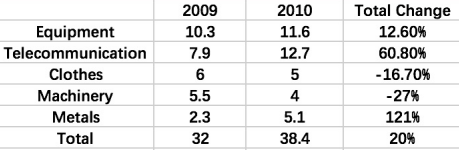
(数据仅供参考。)
Task | 题型类别 | 作文话题 | 题目 | |
Two | 论述类 | 政府类 | Governments should make people responsible for looking after their own local environment. To what extent do you agree or disagree? | |
以上为2018年4月14日雅思考题回顾,如果想了解更多关于雅思考题回顾关信息,请关注启德考培上海考培分校平台,免费获取备考提分解决方案,或欢迎 点击这里 进行网络咨询,我们会给您提供专业的服务。最后,预祝大家雅思考试能取得理想的成绩。
考试热门工具预约
- 测启德在线学习系统,免费开放预约
- 练丰富题库免费预约试用
- 学0元免费预约公开课
- 评实地测试,老师测评,免费开放预约

雅思口语Part2话题卡怎么准备万能素材
2026/09/18 18:46:04

雅思考试前一周怎么冲刺复习
2026/09/18 18:45:55

雅思G类和A类成绩哪个认可度高
2026/09/18 18:45:47

雅思成绩什么时候提交申请最合适
2026/09/18 18:45:38

雅思口语Part1常见问题及回答思路
2026/09/18 18:45:30

托福成绩可以替代雅思申请英国大学吗
2026/09/18 18:45:21